
Presidency hinges on tight races in battleground states
Neither candidate has yet cleared the 270 Electoral College votes needed to win the White House, and the margins were tight in several battleground states.
Neither candidate has yet cleared the 270 Electoral College votes needed to win the White House, and the margins were tight in several battleground states.
The state on Wednesday reported 25 more COVID-19 deaths. Newly reported deaths have reached or topped 25 for nine straight days and have been in double digits 27 times over the past 29 days.
One of the first states to receive rapid, low-cost coronavirus tests from the U.S. government is cautioning against their use in asymptomatic people, a group that were hoped to benefit most from the technology.
The Carmel-based company said its results for the first nine months of 2020 have been “significantly impacted by the COVID-19 pandemic.”
The Dow Jones industrial average closed 554 points higher, led by a surge in bank shares as Treasury yields spiked on speculation that Congress will deliver a spending bill once the election is decided.
Indiana, Missouri, Oklahoma, Iowa, Nebraska, North Dakota, and New Mexico all reported record high hospitalizations this week.
At least 101.9 million people had already voted before Election Day, about 73 percent of the nearly 139 million who cast ballots in 2016, according to data collected by The Associated Press.
Three more Wisconsin players and two additional staffers have tested positive for COVID-19 since Saturday, bringing the program’s total number of active cases to 27. That includes 15 players and 12 staffers.
Indiana native Jeff Meyer began his career as an assistant coach at Purdue in 1978—starting a journey that included stops at South Florida, Liberty, Winthrop, Missouri, Indiana and Michigan—as well as two stints at Butler.
The Indiana State Department of Health on Tuesday reported 2,951 new COVID-19 cases and 50 more deaths due to the coronavirus.
Schools say it’s been like trying to simultaneously build 353 separate puzzles with overlapping and sometimes-missing pieces—and time is running out.
Los Angeles-based Akyumen Industries, which makes smartphones, tablets and smart watches, has tentatively selected the site on Gary’s west side as its first corporate headquarters in the U.S.
Lines of voters formed at some polling places in Indianapolis and its suburbs before the doors to those sites opened in the cold, predawn darkness.
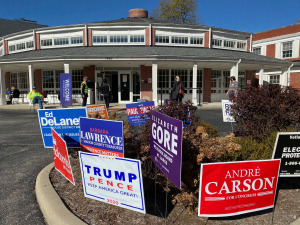
At least 98.1 million people voted before Election Day, or just shy of 71 percent of the nearly 139 million ballots cast during the 2016 presidential election. Experts are predicting record turnout this year.
More than 213,600 Marion County residents have already cast ballots heading into Election Day. Statewide, more than 1.7 million voters cast ballots by mail or in-person at an early-voting location through Monday.
U.S. stocks rebounded from the worst week since March as investors bet on the energy, materials and industrial sectors ahead of Tuesday’s presidential election.
A total absence of fans and the need to play a shortened 72-game schedule to realign the NBA’s typical calendar would cost the league approximately $4 billion of revenue next season. That’s a massive hit for a league with $8 billion in annual revenue.
Departures are not surprising, according to experts, considering not only the mental toll of the pandemic but the fact that many nurses trained in acute care are over 50 and at increased risk of complications if they contract the virus.
Some buildings and businesses in downtown Indianapolis have boarded up windows and taken other security steps to prepare for possible unrest surrounding Election Day.
Total positive COVID-19 cases in Indiana since the beginning of the pandemic have climbed to 185,185.