
Subscriber Benefit
As a subscriber you can listen to articles at work, in the car, or while you work out. Subscribe NowIf the markets have you feeling a little queasy these days, you’re not alone.
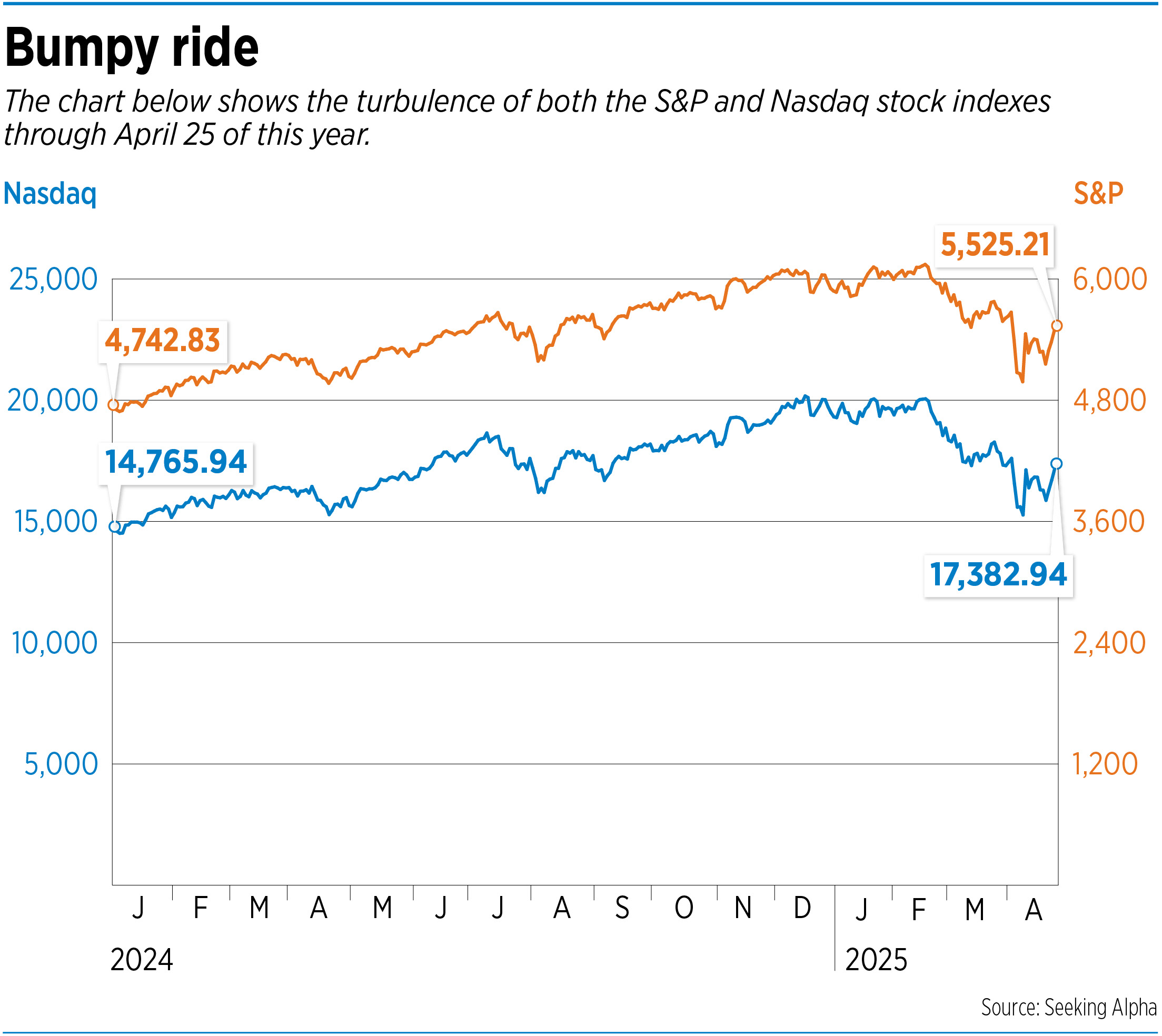
Stock indexes in 2025 have been marked by dramatic ups and downs that mirror the uncertainties around tariffs and other federal policies.

“This type of uncertainty can test even the most seasoned investors,” said Robert “Bo” Ramsey III, chief investment officer at Carmel-based Oxford Financial Group Ltd. The firm serves ultra-wealthy clients—generally, those with at least $30 million in investable assets—and had $19.7 billion in assets under management as of Dec. 31.
The S&P 500, for instance, which closed at 5,868.55 on Jan. 2, closed at an all-time high of 6,144.15 on Feb. 19. By April 8, less than two months later, it had plunged to a closing price of 4,982.77, rebounding to close at 5,456.90 the following day. As of April 24, the S&P had dropped 6.5% since the beginning of the year.
The Nasdaq has had a similar trajectory, closing at 17,166.04 on April 24—down 11% since the beginning of the year.
Amid this uncertainty, Ramsey and other local wealth managers offer some advice for weathering the storm:
◗ Stay cool.

It might be tempting to make dramatic changes to your investments right now, but it’s important to resist that impulse, advisers say.
“If you have a good plan and a reasonable portfolio going into these types of events, the best thing can often be just to kind of stay the course and do nothing,” said John Fidler, chief investment officer at Louisville-based Stock Yards Bank & Trust. “One of the biggest services we can offer is just helping our clients kind of stay objective and rational.”
Stock Yards Bank manages $7 billion in assets for its wealth-management clients, Fidler said. The bank’s wealth management clients typically have $5 million to $10 million in investable assets.
Jeff Mantock, chief investment officer at The National Bank of Indianapolis’ wealth management division, Diamond Capital Management, said he has seen an uptick in queries recently from clients nervous about their portfolios.

“We’ve advised people, this is not a time to panic, but it might be a time to be cautious,” Mantock said.
Diamond Capital Management, whose clients average $1 million to $5 million in investable assets, has $2 billion in total assets under management.
Caution, Mantock said, can mean shifting your portfolio so that it’s less exposed to the stock market swings—maybe moving some money into fixed-income assets like bonds.
In particular, he said, clients who are close to retirement and who don’t already invest in target-date funds might want to rebalance their portfolios to make them less risky.
Target-date funds are designed to automatically adjust their investment mix over time, becoming less risky as the investor approaches retirement.
But for investors who don’t have target-date funds, the stock market’s strong growth over the past few years means that if an investor has not rebalanced his or her portfolio, it might be weighted more heavily toward stocks than it was previously.
As a simple example, consider a hypothetical portfolio that in 2020 included $600,000 in stocks and $400,000 in bonds, creating a $1 million portfolio made up of 60% stocks, 40% bonds. If the performance of those stocks has mirrored the S&P 500 index, which as of April 24 had risen about 94% over the past five years, that same group of stocks is now worth $1.2 million. If the bonds have appreciated 2%, they are now worth $408,000. The total portfolio is now worth $1.5 million, 80% of which is in stocks.

But Mantock generally does not advise making major adjustments. “We’re not believers of market timing—getting out and then getting back in. That’s very difficult to do, almost impossible to do.”
Erin Shaw, the Indianapolis-based market manager for J.P. Morgan Private Bank, offered similar advice. “Don’t panic—stay invested. That is crucial.”
J.P. Morgan Private Bank manages $8 billion in client assets in Indiana and in the Louisville market.
Shaw said the best thing nervous investors can do right now is reach out to their adviser. That adviser can run the numbers on your investments to determine whether you need to make any changes—or the adviser might assure you that you’re still on track.
“If you’re stressed out about this, we need to talk,” Shaw said.
◗ Know your risk tolerance.
When meeting with clients, Shaw said, her general approach is to create a financial plan that carries the least amount of risk possible while still reaching the client’s financial goals.
That said, Shaw acknowledged, clients vary widely in their risk tolerance.
 “I have some clients that are all equity and are fine—they see this [current market uncertainty] as a buying opportunity,” Shaw said last month. “But then you have other clients that need to be on fixed-income [investments] because they can’t sleep at night.”
An investor’s risk tolerance can also shift based on his or her stage of life.
“For clients who are, say, retired and living off their investment accounts, now is probably not the time to be a hero and buy a whole bunch more stocks, because crazy things could happen in the short term,” Fidler said. For this type of client, he said, buying longer-term bonds might be a better move.
But for investors who don’t need to touch their money for at least five years, Fidler said last month, “we’re starting to see some pretty good values in really high-quality businesses that are trading at cheap multiples for the first time in three years.”
◗ Take a wide view.
As scary as the current volatility might seem, it’s not without precedent. The advisers point to downturns in 2001, 2008, 2020 and 2022 from which the market rebounded.
“We’ve seen this 10%-20% drop probably more frequently than people remember,” Ramsey said.
One unique factor about the current turbulence is that it’s driven by the prolonged uncertainty around federal trade policy.
“There’s just a ton of uncertainty right now—and, even from day to day, what the policy is going to be seems to change,” Fidler said.
But that uncertainty won’t last forever, Mantock said.
“In my mind, the Trump administration has a window of opportunity to figure this out. And I think, at the moment, there are advocates that are giving him that time to do that. But if it doesn’t work out, then he’s going to have to do something different,” Mantock said. “The markets are only willing to tolerate this volatility for a period of time. And eventually people are going to have to get reelected for the [2026] midterms.”•
Please enable JavaScript to view this content.
Editor's note: You can comment on IBJ stories by signing in to your IBJ account. If you have not registered, please sign up for a free account now. Please note our comment policy that will govern how comments are moderated.