
Subscriber Benefit
As a subscriber you can listen to articles at work, in the car, or while you work out. Subscribe Now
The best basketball player you’ve never heard of also happens to be one of the most memorable, physical and well-connected to ever come out of central Indiana. Inside the hoops circles of his era, he’s legendary. Outside, he’s anonymous.
Carl Short was an all-city selection at Manual High School. He went on to become a first-team Division II All-American at Newberry College and then played on an Army team that toured the country. He was a successful head coach at Thorntown, Whiteland and Cascade high schools and a longtime teacher and assistant coach in Indianapolis Public Schools, retiring in 2000. He was inducted into the Indiana Basketball Hall of Fame in 2018.
Most of his reputation, however, was built on the hard courts of playgrounds and parks and in dingy gyms in pickup games and the amateur tournaments that once filled the summer in small Indiana towns — events that drew many elite former collegians and warranted newspaper coverage.
Short played with or against everyone from Oscar Robertson to Larry Bird, with several legends in between. Ask any of them, and they’ll praise his toughness and physicality, his rebounding and defense, and acknowledge his willingness to throw a punch if he deemed it necessary.
“When I hit the playing field or floor, I turned it to a different level,” he admits. “I was never dirty, but I was mean. … I took a lot of punches. I bet I took more hits than Muhammad Ali. I’ve got scars all over my face. But nobody ever knocked me down.”
What Short should be remembered for, however, and the reason he’s got a story still worth telling 60 years after he graduated from high school, is for a simple act that, for its time, qualified as courageous and humane: He integrated the playgrounds in Indianapolis.
Unbiased, unafraid and undeterred in his desire to become a better player, he broke through — pedaled through, actually — a color barrier that might as well have been the Berlin Wall by venturing to the court within the public housing project at Lockefield Gardens in the early 1950s. It was known as the Dust Bowl because of its original dirt surface but had been paved by the time he played there.
Whether you want to credit him for being color-blind or for having insight or for simply finding the best competition, Short became a pioneer who influenced others.
“Mom and Dad brought us up as religious people,” he says. “They were from Kentucky, but they always said, ‘All people are the same. Those colored folks are just as good as we are, and in some cases better.’”
Birth of a work ethic
There’s a backstory to Short’s motivation.
He was the fifth of 12 kids who grew up in a three-bedroom house on Indy’s south side. He slept on a mattress in a hallway just outside the kitchen and in fact wouldn’t sleep in an actual bed every night until he got to college. His parents told him he was guaranteed “three hots and a cot” but would have to earn the rest.
His father set the tone by working two jobs six days a week, at a factory and running a service station on 16th Street. It was the only way to feed a family of 14. Carl talked his way into landing a paper route with The Indianapolis Times when he was just 7 years old and kept the job for six years. He worked alone in the afternoons Monday through Saturday, and his sister volunteered to help on Sunday mornings.
From meeting so many people, he was able to line up jobs mowing lawns and shoveling snow. And from all that work, he was able to save enough money to buy a bicycle. And that bicycle took him into a different world.
A Black teammate at Manual, Charlie Cook, told him about the games played on the court in Lockefield Gardens. Short didn’t care that no white kids played there; he wanted to see it for himself. The first time he rode his bike there during the summer before his sophomore year of high school, he stood and watched and then went home. The next time, a player sprained an ankle, and a replacement was needed to maintain the full-court game.
“You play ball?” one of the players asked.
Short became a popular addition to the games, picked early when sides were chosen, because he was strong, aggressive and a poor shooter — the perfect role player for a team filled with guys who liked to shoot.
“I got the white boy,” a team captain would say, and he was in.
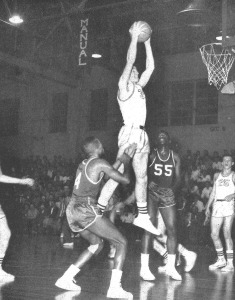
He was welcomed by the other players and even cheered by the spectators watching from the sideline or apartment windows overlooking the court. Before long, he befriended the best player, Robertson, who reciprocated by bringing a couple of carloads of his Crispus Attucks teammates for games at the outdoor court next to Manual, off Madison Avenue. Spectators surrounded the courts to watch those games, too. The teams in those games were divided by school, not race.
“We were competitive, but we couldn’t beat them,” Short recalls of the Attucks kids. “That’s what I wanted, though, tough competition.”
Short’s comfort zone in those games enabled him to be himself. Which meant to play physically. Which meant occasional conflicts. He harbored no prejudices, which meant he inflicted his style of play on everyone equally.
“He’d take it right at the Black guys,” recalls Larry Humes, a Black player who was Indiana’s Mr. Basketball in 1962 and an All-American at the University of Evansville in 1965 and 1966. “He wasn’t afraid of anybody.”
Short has endless stories.
One time at an outdoor tournament in Zionsville, he got into a fight with Boo Ellis, a standout from Attucks. The two were rolling around on the pavement trading punches before they were separated.
He once retaliated for some apparent misdeed by tackling former Marian University star Mike Noone while running full speed on the court, sparking a fight that ended up in the bleachers.
And there was the time he hit a game-winning jumper over recently graduated Notre Dame star Jay Miller in a summer tournament and celebrated too much for Miller’s liking.
“How did a chump like you make All-American?” Miller asked.
“Playing against punks like you,” Short replied.
Miller punched Short in the throat. Short tried to retaliate but was restrained. He couldn’t talk normally for about a month. The following winter, Miller was playing for the Pacers.
Keeping good company
It’s not like Short had a fight in every game. Mostly he just played as hard and as often as possible. The roster of standout players with whom he shared court time could fill a hall of fame. Citing only Indiana Mr. Basketballs as examples, you could include Hallie Bryant (1953), Bobby Plump (’54), Robertson (’56), Jimmy Rayl (’59), Tom and Dick Van Arsdale (’61), Humes, Billy Keller (’65) and Rick Mount (’66), among others.
He stays in touch with many of them. And they all remember him.
Plump, playing for a team sponsored by 7-Up, once scored 30 points and hit the game-winning free throws to beat Short’s F&M Oil team in an AAU tournament in Greenfield in 1968. Short, meanwhile, scored 53 points.
“I’m not sure I ever saw a player his size that strong,” Plump recalls. “He could knock guys out of bounds just going up for a shot underneath the basket.”
Short was particularly close with fellow Manual alums the Van Arsdales. He began taking them to games at Lockefield and other places around the city when they were eighth graders — too young to play but old enough to appreciate.
“Dick and I kind of idolized Carl because he was five years ahead of us, and he was a great player,” Tom says. “He was a mentor and kind of watched over us.”
The Van Arsdales played at Lockefield when they got older. They also gravitated to the YMCA on Senate Avenue, at the time the only YMCA available to Black residents.
“We’d never feel threatened to go to those places,” Tom says. “Dick and I would go to the YMCA downtown, and we were the only two white guys in there.”
Short also had a special relationship with Mount. They met while playing in Lebanon’s park and worked out together over the summers of 1970 and 1971, six days most weeks, when Mount prepared for the Pacers’ training camp. They ran, lifted weights and played rugged full-court one-on-one games in which tempers occasionally flared. Such as the time Mount threw a ball and hit Short in the nose.
“I liked him because he roughed me up,” Mount says. “That’s what I wanted. People would say, ‘Carl, knock that off.’ I said, ‘No, I want him to play me that way.’”
In his late 30s, Short even played against Larry Bird in a summer tournament game in Lebanon before Bird enrolled at Indiana State.
“You’re not bad for an old guy,” Bird said after the game.
That was just about the end of Short’s playing career, one notable for more than sharp elbows and clenched fists.
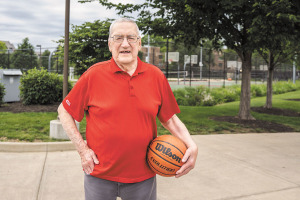
The Dust Bowl court he integrated is long gone, replaced by two classy fenced-in courts that are open only to Indiana University Indianapolis students. But an 88-year-old man with battle scars on his face and a good heart could tell them about a much different time.•
__________
Montieth, an Indianapolis native, is a longtime newspaper reporter and freelance writer. He is the author of three books: “Passion Play: Coach Gene Keady and the Purdue Boilermakers,” “Reborn: The Pacers and the Return of Pro Basketball to Indianapolis,” and “Extra Innings: My Life in Baseball,” with former Indianapolis Indians President Max Schumacher.
Please enable JavaScript to view this content.
Great story! I had never heard about Carl Short. The story paints a fascinating picture of the Indy pickup basketball scene in the 50’s and 60’s.