
Subscriber Benefit
As a subscriber you can listen to articles at work, in the car, or while you work out. Subscribe Now
After he graduates, Butler University junior Dominic Mininni wants to own a concrete and asphalt business.
“I love to do stuff outside, and I’ve had family that’s been in the construction world, in the industry, and it’s just something that’s always intrigued me,” he said.

What he doesn’t want to do is start his own business, which in his eyes seems too risky. Instead, Mininni wants to get in the game by purchasing an existing company.
“In my eyes, it feels like acquisition is a great avenue to explore right now,” said Mininni, who is from the Chicago suburb of Elk Grove Village and is majoring in entrepreneurship and innovation.
He is not alone. For a variety of reasons, a growing number of aspiring entrepreneurs of all ages are choosing to become business owners by acquiring a company rather than starting one from scratch.
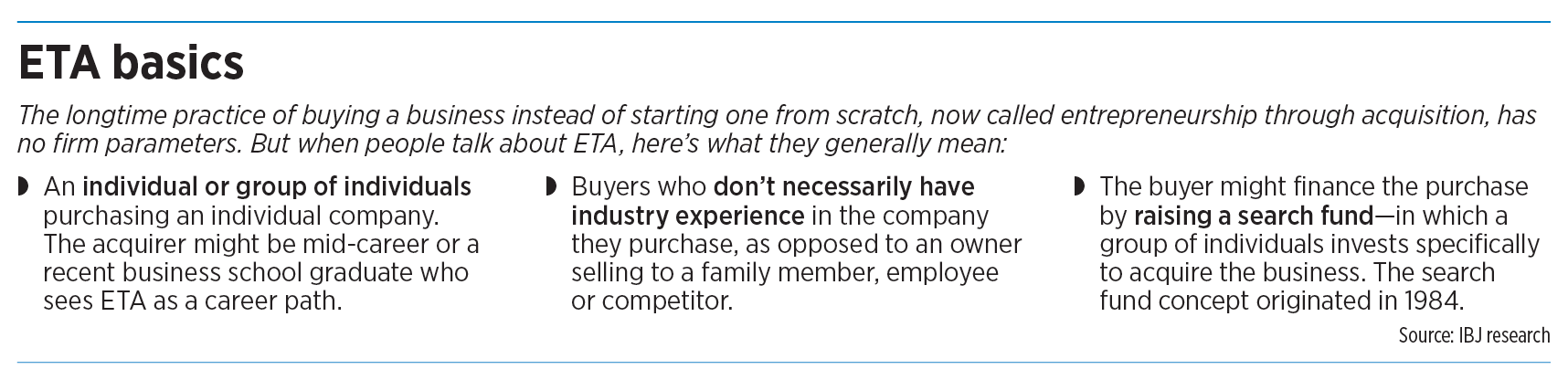
The practice has even acquired its own nickname: ETA, which stands for entrepreneurship through acquisition.
And it’s a topic that has caught the attention of entities such as Butler University, which is working to develop ETA-focused educational offerings for students and the wider community, and the state of Indiana, which sees ETA as an avenue for promoting Hoosier entrepreneurship, a priority of Gov. Mike Braun.

“We believe ETA offers an exciting alternative for Hoosiers ready to become business owners,” Indiana Entrepreneurship and Innovation Director Brian Schutt told IBJ via email. “Though there is still risk, acquiring an existing business offers great potential outcomes for both owners and their communities.”
Schutt was named director of the newly created Office of Entrepreneurship and Innovation in July. He’s still working to develop official priorities and programming, but he’s already part of the local conversation about ETA. Last month, Schutt moderated a panel discussion about ETA at the Rally innovation conference in Indianapolis. He was also a panelist at an ETA-focused meetup at Butler.
“This has just become such a hot space,” said Maggie Ference, the Columbus, Ohio-based director of Huntington Bank’s Small Business Administration program and the bank’s resident expert in ETA.

The practice of buying a business, of course, is nothing new. But it has particularly caught on among recent college graduates, Ference said. “This is very, very hot among business students, MBA students.”
And in the ETA model, those potential buyers have no connection to the business they wish to buy. They’re not a family member, employee or competitor of the business owner.
It’s difficult to directly quantify the uptick in ETA activity. Ference, for instance, said Huntington does not track which of its Small Business Administration loans are for buyers with a connection to the business and which are not. Huntington is among the nation’s most active SBA lenders.
One indicator of ETA’s growing popularity: the increased use of a niche financing tool called a search fund. The concept, created in 1984, refers to a fund in which a group of individuals invests for the purpose of buying a business.
The Stanford University Search Fund Study, which has tracked search fund activity since 1996, said in its most recent report that, through the end of 2023, a total of 681 search funds had been launched in the United States and Canada since the practice began—not a large accumulation across two countries over almost 40 years. In fact, it took 35 years to launch 400 such funds. But in the next four years, from 2019 to 2023, almost 300 more were launched.
And interest has continued to rise.

Ed Mysogland, managing partner of Indianapolis-based business brokerage Indiana Business Advisors, said he’s seen an explosion in buyer interest in the past two years, including more younger buyers and more buyers who are using search funds.
“There’s just so much buyer activity out there right now,” Mysogland said. “In the last 18 months, this [buyer interest] has gone off the charts.”
As an example of the feeding frenzy, Mysogland said the last 17 business sales his firm closed involved an average of 157 nondisclosure agreements per deal. In other words: Before each of those sales, about 150 potential buyers were interested enough to sign an NDA that allowed them to learn details about the business for sale.
Traditionally, a business broker’s job has involved finding potential acquirers for a client who wants to sell his or her business. But Mysogland said a significant part of his firm’s business right now involves helping owners evaluate the potential buyers that have already come forward.
Building a community
In January, Bloomington-based entrepreneur and investor Pat East left his position as executive director at The Mill, a Bloomington coworking space and entrepreneurship center, in search of his next opportunity.

He’s zoned in on ETA as that opportunity. East is currently searching for a business to buy—and he also sees an opportunity to help build Indiana’s ETA community.
As East was learning about ETA, he wanted to connect with others interested in the topic. He couldn’t find an existing community in Indiana, so he hosted a gathering of his own in Bloomington last month.
“I went into it not with a specific mission or purpose. It was more just like, ‘Hey, let’s try this and see how it goes,’” East said of that Bloomington gathering.
That meetup attracted 25 participants and led to his hosting similar gatherings in Lafayette and at Butler. The Lafayette event drew about 40 people, and the Butler event drew about 75, including college students, mid-career “corporate refugees” looking for a career change and others.
East is hosting another three ETA meetups in coming weeks in Fishers, Fort Wayne and online, and he’s involved in planning an ETA conference likely to take place early next year in Indianapolis.
Nick Smarrelli, the director of Butler Entrepreneurship, also sees a need for more ETA-focused educational offerings. Butler Entrepreneurship exists to help students, faculty and alumni pursue entrepreneurial ambitions. ETA is one of Butler Entrepreneurship’s four focus areas.
“I think the state has a lot of disparate resources as it relates to [startup] accelerators and incubators and startups—but entrepreneurship through acquisition just doesn’t have a lot of meat to it,” Smarrelli said. “We don’t see a lot of community here. So we see this as a huge gap in the market.”
Smarrelli, whose duties include teaching entrepreneurship at Butler, has covered the topic of ETA with his students. He said Butler plans to beef up its offerings on the topic by adding an ETA-focused for-credit class next fall.
“It’s very hard to get a class started in academia—we’re not very fast people—and so the fact that this is becoming a class really represents the continued focus and opportunity that we see as it relates to entrepreneurship through acquisition,” Smarrelli said.
Butler also plans to launch ETA programming for non-students, he added.
Early next year, the university plans to offer a 12-week ETA certification program that covers topics such as how to source and evaluate potential acquisitions, how to finance a business purchase, and what new owners should do in their first months after acquiring a business. Initially, the program will focus on people who want to buy a business. Later, Smarrelli said, the plan is to also develop resources for business owners who want to sell their companies.
The ETA program, Smarrelli said, is being developed in partnership with East, chambers of commerce and Indiana Small Business Development Center offices around the state, and Schutt, Indiana’s entrepreneurship and innovation director. It will aim to reach beyond the Butler campus and beyond central Indiana, Smarrelli said.
“The target audience isn’t necessarily students. Rather, it’s the greater state, and not just Indy,” he told IBJ.


ETA’s attractions
Why is ETA such a hot topic right now? Those involved in the entrepreneurship and business acquisition world offer several reasons.
Ference, the Huntington Bank executive, said marketing is part of the reason—simply by giving an age-old activity a catchy nickname, ETA is attracting a new wave of interest.
“Naming something gives it such power,” Ference said. “It’s helping to legitimize that activity.”
But there are also other factors. One is that entrepreneurs are seeing ETA as a safer path than starting a business from scratch.
Mininni, the Butler student, said startup culture is not appealing to him because of the risk involved.
“I think there’s a lot of great ideas out there, and I think one in 10 of those ideas are actually going to take off,” he said.
In fact, Mininni came close to launching his own company—an online platform for allergy sufferers. But he pulled the plug before going to market because he discovered a large competitor was already offering something similar.
Another downside to startups, in Mininni’s view: They might not land paying customers for quite some time.
“With the way startups work, it could take you five years to make your first amount of revenue,” Mininni said. “When you go into a business that you acquire, you’re making revenue [in] year one.”
East said the idea of existing revenue can make the ETA option appealing to mid-career entrepreneurs like him. Rather than give up a steady paycheck for the uncertainty of a startup, he said, through ETA “you can buy into a business that can pay that same salary.”
Another factor: demographics. According to the U.S. Census Bureau, more than half of the nation’s business owners are age 55 or older.
And some of those aging business owners don’t have family members who want to take over the company, which creates an opportunity for ETA entrepreneurs to step in, Smarrelli said.
ETA entrepreneurs might even save some businesses from closure.
In data released earlier this year, the polling organization Gallup Inc. said 13% of business owners age 55 or older said they plan to close their business within five years. And 14% said they did not know or did not have a plan for the next five years. In comparison, 11% of these owners said they plan to sell the business, and 8% said they plan to transfer ownership.
“This is really a chance to see small businesses survive generational changes,” Ference said.•
Please enable JavaScript to view this content.
It seems many aspiring professionals want to take the express elevator to the top. Who wants to climb anymore? The problem is, buying a business without real-world experience carries real risk, too. What you learn by working within a company or building one from the ground up is invaluable. It’s far better to break something you started than to break something you bought or leveraged. After all, what you buy might also be the livelihood of others. Take your time—success rarely comes quickly, and the climb teaches you more than the shortcut ever will.
So no one should ever sell a business?
Your take is when an owner retires the business should die with them?
JJ Frankie — not at all. I’m a big believer in acquiring a business. What I question is whether a recent graduate, without much real-world or on-the-job experience, is truly ready for that responsibility.
John, its a fair comment, and my takeaway from your comment is that both start up and buying a business involve significant risk. From a capital deployment standpoint, bringing in new ownership to reinvigorate a business, leveraging existing assets and talent, can be a better alternative to raising new capital. Its not without risk, and any new entrepreneur needs to consider their own strengths and surround themselves with complementary capabilities. This ETA approach as long as it takes the risks you outline into consideration can be a good alternative.