
Subscriber Benefit
As a subscriber you can listen to articles at work, in the car, or while you work out. Subscribe Now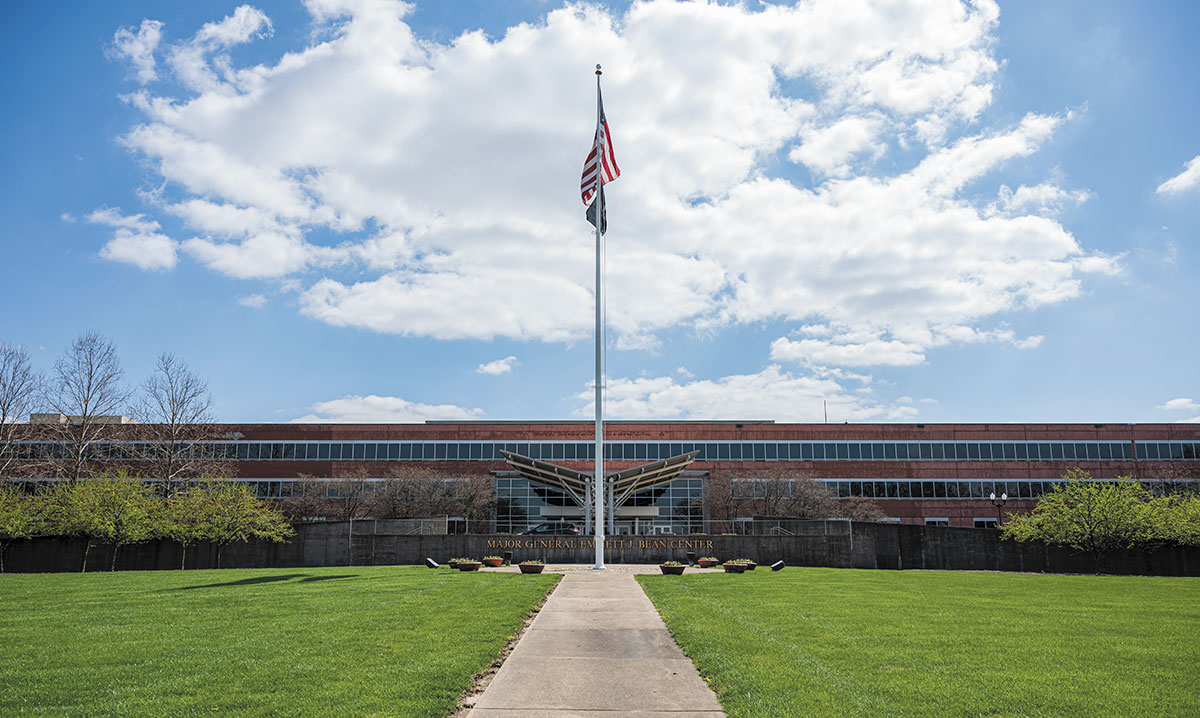
It’s been more than a month since the General Services Administration published—then abruptly deleted—a list of more than 440 federally owned properties it planned to put up for sale, including the downtown Minton-Capehart Federal Building and the Maj. Gen. Emmett J. Bean Federal Center in Lawrence.
But city officials in Indianapolis and Lawrence said little else has been shared about the properties—or whether they’re still at risk of disposal.
Initially, the two government-owned buildings were deemed “not core to government operations” by the entity that manages the entire federal real estate portfolio, even as the buildings constitute a majority of the space used by more than 12,000 federal workers in central Indiana.
Likewise, it’s still unclear whether the Trump administration’s Department of Government Efficiency plans to continue slashing leases for federal space in privately held buildings in Indianapolis and beyond. A handful of the 97 leases in Indiana have been canceled, and some 675 government leases have been canceled nationwide.
Brokers representing building owners have generally refrained from discussing the issue publicly, either because of the fluidity of the situation or because their companies carry government leasing contracts.


Lawrence Mayor Deb Whitfield, a Democrat in her first term, said she met with fellow Democrat U.S. Rep. Andre Carson during a recent trip to Washington, D.C., but the 7th District representative had little information to share about what might become of the Bean Center, which serves as headquarters for the Defense Finance and Accounting Service, a division of the U.S. Department of Defense.
“At this point, we have not heard anything directly from the federal government about any plans to sell the building,” Whitfield said.
The 1.58-million-square-foot property spans more than 72 acres at East 56th Street and North Post Road and houses about 4,000 of the 13,000 federal employees responsible for managing all financial services for the Defense Department, including five branches of the military as well as civilian employees, retirees and major defense contractors and vendors.
Carson told IBJ in March that he was still trying to find out more about plans for all of Marion County’s federal holdings. But he said the potential disposal of the Lawrence property was of particular concern, as it employs thousands of people across a footprint about one-quarter the size of the Pentagon.
The structure was initially the single-largest federal office building on the disposal list, followed by a 1.57-million-square-foot facility in Atlanta and a federal building in Cleveland that is nearly 1.2 million square feet.
“I’m all for efficiency, and I’m certainly for austerity as a member of the New Democrat Coalition,” Carson said. “But that’s not what this is, and it’s not what DOGE is doing. [It’s] actually creating more work by creating problems that don’t exist.”
He said the “idea that DOGE would even consider selling these two federal buildings, it’s just ridiculous to me.”
Surviving
According to the General Services Administration website, only 23 properties are now classified as “non-core” and are for sale. Those properties have been listed in three batches over the past several weeks—all in the time since the GSA took down its initial list of 440 properties to be sold. Neither the Lawrence nor Indianapolis buildings had been relisted as part of that process as of Monday.
The Bean Center opened in 1943 as an Army finance center and was part of Fort Benjamin Harrison, a military installation that opened in 1904 and was used over the years for Army training and mobilization, administration, health care and other functions.
But in the post-Cold War era, Congress pushed for military consolidation. The Defense Base Closure and Realignment Act of 1990 put Fort Harrison on a list of assets to be decommissioned. Local leaders pushed back on the move, but they were unable to save the base. About 1,700 acres were converted into Fort Harrison State Park, and a reuse commission has spent three decades redeveloping much of the rest of the property into residential, retail and commercial uses.
At the same time as the base decommissionings, federal officials were also consolidating finance operations into a single division: Defense Finance and Accounting Service. In 1994, the Defense Department selected Indianapolis as one of five major consolidated sites of DFAS, which saved the Bean Center from closure.
In 2005, the Bean Center survived another round of budget cuts. In fact, DFAS moved its headquarters from Arlington, Virginia, to Indianapolis.
Whitfield said she is eager to maintain a dialogue with federal officials and other local leaders about ensuring a future for the Bean Center. She said the workforce is vital to the redeveloped Fort Ben area.
“We have a great opportunity to invest and build this area, and the amount of folks that are in that building could be very important to our economic development,” she said. “I am going to have to say, in this instance, we’re going to have to be reactive, not proactive, and that’s unfortunate for us.”
Carson said he’s concerned about the Bean Center in part because, “there’s no thoughtfulness about how [DOGE’s] decisions impact people and our economy.”
“DFAS provides paychecks to our service members,” Carson said. “That’s not optional to me. It even processes Donald Trump’s paycheck.”
Finding value
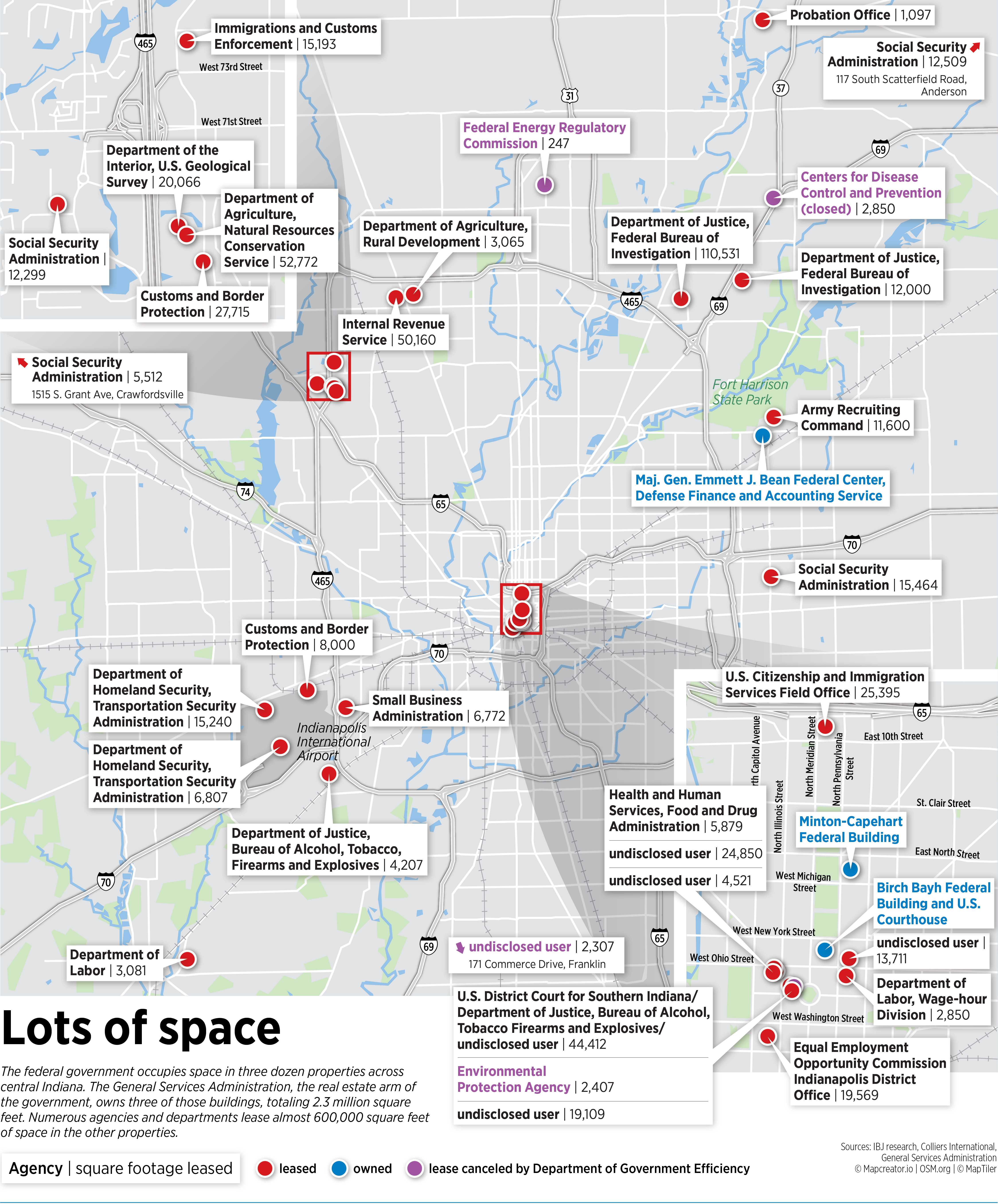
In total, the U.S. government owns 10 properties across Indiana, with office leases in another 97. It occupies nearly 2.9 million square feet between its ownership and lease agreements in the central Indiana office market alone. That accounts for 7% of the market’s 39.7 million square feet of office space, according to research from the Indianapolis division of Chicago-based brokerage Cushman & Wakefield.
While most of the federal government’s space is from its three owned buildings—the Bean Center, and the Minton-Capehart building and U.S. Courthouse downtown—the rest comes from lease agreements with private property owners.
A few of those leases have already been canceled, including small spaces for the Federal Energy Regulatory Commission in Carmel and the Centers for Disease Control and Prevention in Fishers.
At nearly 400,000 square feet, Minton-Capehart Federal Building, 575 N. Pennsylvania St., accounts for almost half of the federal office inventory downtown. The building’s numerous users include the downtown offices for the Internal Revenue Service, Department of Veterans Affairs and Social Security Administration.
In January, a federal immigration court opened in the Minton-Capehart building to hear Indiana cases that had been assigned to a court in Chicago. The court employs about 40 people, including seven immigration judges.
Gordon Hendry, founder and managing director of Indianapolis real estate firm HRE Advisors, said while there’s no indication DOGE actions will deplete a large number of federal workers downtown, he’s still concerned about losing even a fraction of the workforce.
Federal workers “have a tremendous value” for downtown, Hendry said, in part because more of them returned to in-office work after the pandemic than did workers in private companies.
“They help keep downtown fuller, while also helping support the local economy,” he said. “So the notion that we would essentially shut down federal offices in our downtown and elsewhere is very troubling for our market, not to mention the potential glut of additional office space it would create in what’s already a very challenged office market.”
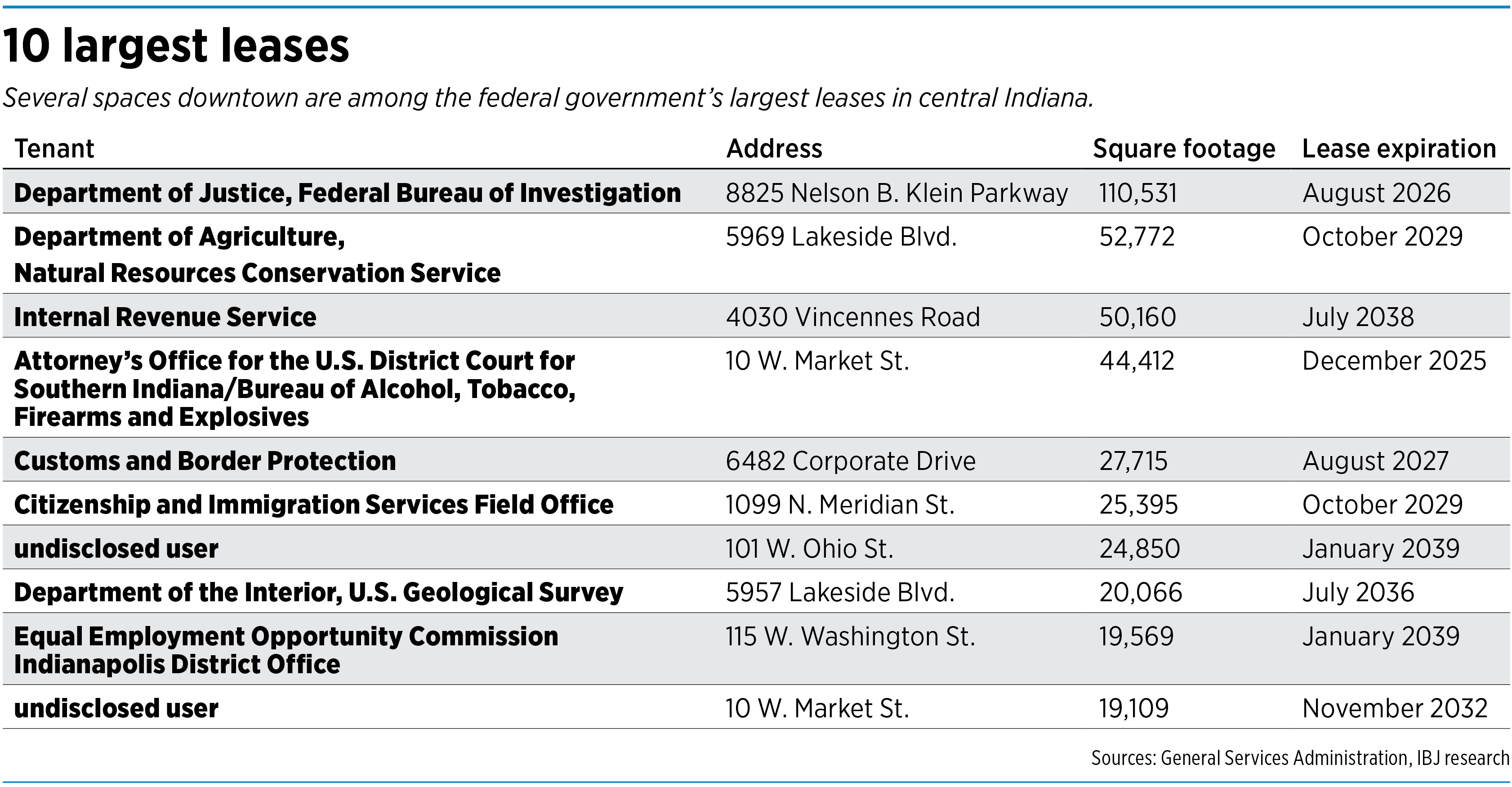
Of the space leased by the federal government, most is outside downtown. A large portion is on the northwest side, and the Transportation Security Administration and Bureau of Alcohol, Tobacco, Firearms and Explosives each have operations at or near the Indianapolis International Airport. On the north side, the FBI has a 110,000 square foot building near Castleton Square Mall.
Lots of uncertainty
Andrew Urban, senior vice president of occupier services for the Indianapolis office of Toronto-based Colliers International, said the federal government’s office space makes up only a fraction of downtown’s office inventory—about 4% of 11.8 million square feet. And of that, only about 120,000 square feet is leased.

Because of that, Urban said, the city would likely fare better under large cancellations or closures than would places like St. Louis and Kansas City, Missouri, which have larger federal presences in their urban cores.
St. Louis has a 1-million-square-foot, 20-story office building downtown owned and used by the government, as well as a few other General Services Administration holdings. Kansas City is home to a 1.2 million-square-foot tower that was listed on the administration’s initial disposal list.
“Overall, every city kind of stands on its own and has its own market dynamics going on. So at the end of the day, the impact and the fallout varies a little bit,” Urban said. Indianapolis’ federal office “percentage is fairly low. Obviously, we would hate to see any of that space come back to the market, but at the same time, I don’t think it would be catastrophic.”
Officials with the city of Indianapolis have generally stayed quiet regarding the federal government’s office overhaul, particularly as it relates to the Minton-Capehart building. A representative for the city declined to comment for this story.
To Urban, the biggest challenge is that the federal government’s actions are unknowable.
“All these scenarios we can talk about are hypothetical in nature, but I certainly think it’s a good thing for people to be aware of and to think about how it could impact their communities,” he said.
Taylor Schaffer, president of civic organization Downtown Indy Inc., said the group views federal office workers as “vital” to the strength of downtown. She said every person who works in an office tower—particularly with many companies moving to the suburbs or to complexes in the outer reaches of downtown, including the Bottleworks District and The Stutz—are important for downtown’s overall health.
Schaffer, a former deputy chief under Mayor Joe Hogsett, also said she’s heard no information about whether the federal government might reduce its office footprint.
“It’s something that we’re closely monitoring,” she said. “Obviously, those plans still seem to be in an evolutionary stage, so it’s something we’re really closely keeping an eye on.”
Schaffer said it’s too soon to consider contingencies for the Minton-Capehart building, including what might happen if the administration began to look for a buyer, especially given other challenges the organization is working to tackle.
“It’s just too soon [to plan], especially as we’ve seen plans and directives continue to evolve from the Trump administration,” she said. “While federal workers are an important piece of this, we’re still thinking about what safety, what cleanliness, what activation, what programming looks like for the downtown workforce as a whole and still trying to keep those lines of communication open with our federal, state and local partners.”
The sentiment was echoed by Carson, who said that while he sits on the other side of the political aisle, there is room for dialogue with the Trump administration on the matter.
“I think there is a space outside of the political pageantry that we’re seeing and the theatrics where we can work together,” Carson said. “I think we have to look at what President Trump says versus what he does. He’s a masterful marketer, and I think his provocations cause so much chaos and media attention, he’s able to control and leverage it to his benefit. But he can’t do these things at the expense of the American people.”•
Please enable JavaScript to view this content.
Nice map, well done!
Looks like we could cut some expenses with dumping some of those leases and properties.