The contract is part of the U.S. government’s effort to double its procurement of rapid COVID-19 tests to be delivered for free to Americans through a forthcoming federal website.
The White House said the four-test limit on website orders will be applied to each residential address and will apply to the first tranche of 500 million tests. It estimates that the cost of purchasing and distributing the first block of tests at $4 billion.
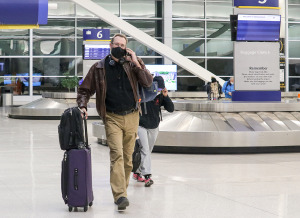
Not only do you have to rearrange plans to visit customers or attend conferences, but you suddenly need to isolate in a hotel room, find restaurants that deliver, and perhaps reschedule flight and hotel plans.
The federal government plans will double to 1 billion the rapid, at-home COVID-19 tests to be distributed free to Americans, along with “high-quality masks.”
The complaint, filed Sunday in a federal court in Illinois, claims the universities use a shared methodology to calculate financial need in a way that reduces institutional dollars to students from working- and middle-class families.
With the highly transmissible omicron variant spurring record levels of infections and hospitalizations, experts have repeatedly urged the Biden administration to recommend the better-quality masks rather than cloth coverings to protect against an airborne virus.
The federal government has resumed shipping all three monoclonal antibody treatments—including one made by Indianapolis-based Eli Lilly and Co.—that are authorized for early-stage COVID-19 to states despite evidence that two might be ineffective against the omicron variant.
Boosters already are recommended for everyone 16 and older, and federal regulators on Monday decided they’re also warranted for 12- to 15-year-olds once enough time has passed since their last dose.
By Christmas, nearly 63% of adult Hoosiers had been vaccinated, with 36% of adults having received a booster shot. But among all Hoosiers eligible (including children 5 years and older), only about 52% of the state’s population over the age of 5 had been fully vaccinated, putting Indiana near the bottom among states.
The pandemic has not slowed Indianapolis-based venture studio High Alpha—and in fact, the move to remote work and increasing dependence on technology has probably sped up its activity.
U.S. health officials on Monday cut isolation recommendations for Americans who catch the coronavirus from 10 to five days, and similarly shortened the time that close contacts need to quarantine.
The Biden administration, which last week announced a plan to offer 500 million at-home tests to Americans sometime next month, has faced criticism in recent days over its failure to prepare an adequate supply of tests.
Indianapolis tourism officials say the city’s convention and events business should be almost fully recovered by the end of 2022—at least based on projections for attendance and economic impact.
There were no government orders or local restrictions prompting the closures this time around. Rather, businesses were forced to close due to too many staffers getting COVID—or out of caution.
The strange clotting problem has caused nine confirmed deaths after J&J vaccinations—while the Pfizer and Moderna vaccines don’t come with that risk and also appear more effective, said advisers to the Centers for Disease Control and Prevention.
The prospect of new pills to fight COVID-19 can’t come soon enough for communities in the Northeast and Midwest, where many hospitals are once again being overloaded by incoming virus cases.