Woody Myers, a former state health commissioner and Anthem Inc. executive, said he thinks the state needs to ramp up testing significantly before considering re-opening the economy.
The Indianapolis-based drugmaker, which reported quarterly earnings Thursday, warned it could feel the effects of rising unemployment, a decrease in new prescriptions, and downward pricing pressure from government health care systems.
Increasingly, doctors are reporting bizarre, unsettling cases that don’t seem to follow any of the textbooks they’ve trained on. The concern is so acute some doctor groups have raised the controversial possibility of giving preventive blood thinners to everyone with COVID-19.
Even as governors, mayors and the federal government urge or require Americans to wear masks in stores, transit systems and other public spaces to contain the spread of the novel coronavirus, the nation is divided about whether to comply.
The roster of potential therapies includes new antivirals, older antivirals, anti-inflammatory drugs, stem cell therapies, antiparasitic drugs, and even treatments for erectile dysfunction.
Indiana University Health said admissions of COVID-19 patients at its 16 hospitals have been “pretty flat” over the past six or seven days, but it’s unclear whether the surge has peaked.
Some hospitals have reported unusually high death rates for coronavirus patients on ventilators, and some doctors worry that the machines could be harming certain patients.
Health-data specialists at universities and research institutes in Indianapolis expect the virus to hit its peak between mid-April and early May, packing a punch that could cause about 800 new positive COVID-19 cases a day.
Under Beering’s 18-year-tenure, Purdue University grew its liberal arts programs, promoted diversity and added 20 major buildings. Enrollment of international students grew threefold to become the largest at any public university.
Even as hospitals scrounge for professionals from the industry to treat the burgeoning numbers of people with COVID-19, others are on the sidelines as elective procedures, diagnostics and appointments are canceled or postponed.
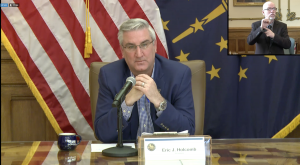
Gov. Eric Holcomb acknowledged the state is facing a potential mental-health crisis, and said he is committed to offering services to Hoosiers who are feeling troubled.
In this Nov. 26, 1945, photo, two women are at an Indianapolis department store to promote a fundraising effort for the State Board of Health’s infantile paralysis clinical research and for Kenny Institute treatment programs.
Gov. Eric Holcomb’s directive calls for all Indiana health care facilities to cancel or postpone non-urgent surgical procedures amid the coronavirus pandemic.
State leaders on Wednesday defended “targeted testing”—or restricting tests to certain high-risk groups—saying they didn’t want to deplete test supplies.
Gov. Eric Holcomb on Wednesday announced a campaign called “IN this together” to encourage citizens to follow stay-at-home and social-distancing guidelines during the pandemic.
The decision means perhaps tens of thousands of additional people can get tested at Lilly’s drive-thru, including people who work in grocery stores, pharmacies, banks and other places listed by the state as essential.