Other parts of Indiana’s HIP 3.0 proposal are still under consideration, including an expansion on provider taxes, cost-sharing requirements and wellness incentives.
GeoH offers a software platform that home care agencies can use for things like billing, staff scheduling, payroll and analytics, as well as a handful of other services.
As dozens of GOP legislators talked with Trump officials about a variety of topics, Democrat lawmakers called out their colleagues and Hoosiers gathered to protest the maneuver.
Over the course of a decade, Indiana’s per-enrollee costs for certain Medicaid recipients are expected to surge by 43% and 72% for lower-income and elderly Hoosiers, respectively.
The Indiana Legislative Council on Wednesday approved the nearly two dozen topics that lawmakers will examine in interim study committees through the end of October.
Ongoing negotiations in Washington, D.C., could undermine or fundamentally alter the third iteration of the Healthy Indiana Plan, otherwise known as HIP.
In one of the most high-profile cases of the term, the court voted 6-3 along ideological lines to uphold a state law that prohibits adolescents from using hormones and puberty blockers for gender transition.
Gov. Mike Braun warned that Indiana needs swift solutions for its bevy of water and energy “challenges” to support the state’s expanding manufacturing sector.
Gov. Mike Braun signed 243 bills into law during this year, including more than 60 on Tuesday. Here’s a rundown of some of the most significant pieces of legislation that made it through this year’s General Assembly.
Controversial language targeting homeless Hoosiers, regulating marijuana-like products and cracking down on illicit massage parlors perished in the final hours of this year’s General Assembly.
The Indiana Legislature approved a pared-down $46.2 billion state budget bill early Friday morning that will triple the state’s cigarette tax and cut funding for a wide swath of entities and programs.
Federal funding was spent in Indiana on everything from entitlement programs to defense, agriculture and education, according to an Indiana Fiscal Policy Institute analysis.
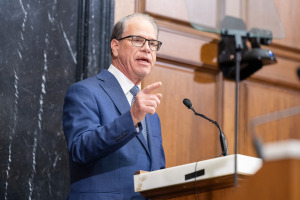
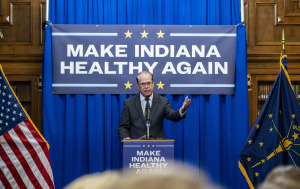
Gov. Mike Braun was joined by top Trump health officials Robert F. Kennedy Jr. and Dr. Mehmet Oz as he introduced nine executive orders signed under his “Make Indiana Healthy Again” initiative Tuesday.
Gov. Mike Braun’s new initiative borrows from Kennedy’s “Make America Healthy Again” slogan, which Kennedy, the U.S. health secretary, borrowed from President Donald Trump’s campaign.