
Subscriber Benefit
As a subscriber you can listen to articles at work, in the car, or while you work out. Subscribe Now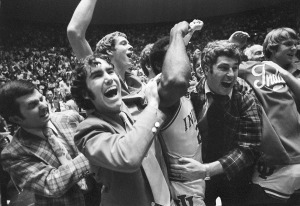
 Click here to see more Final Four stories at The Tip-Off.
Think of it this way: It was a team so talented that all five starters played at least five seasons in the NBA, with four of them having been among the first 11 draft picks. And yet it was a team with sublime chemistry, everyone accepting his assigned tasks.
It seems unlikely another college basketball team will ever match such a confluence of skill and cohesion. Perhaps one never has. We know this much for sure, at least: No team in the past 50 years has matched it for perfection.
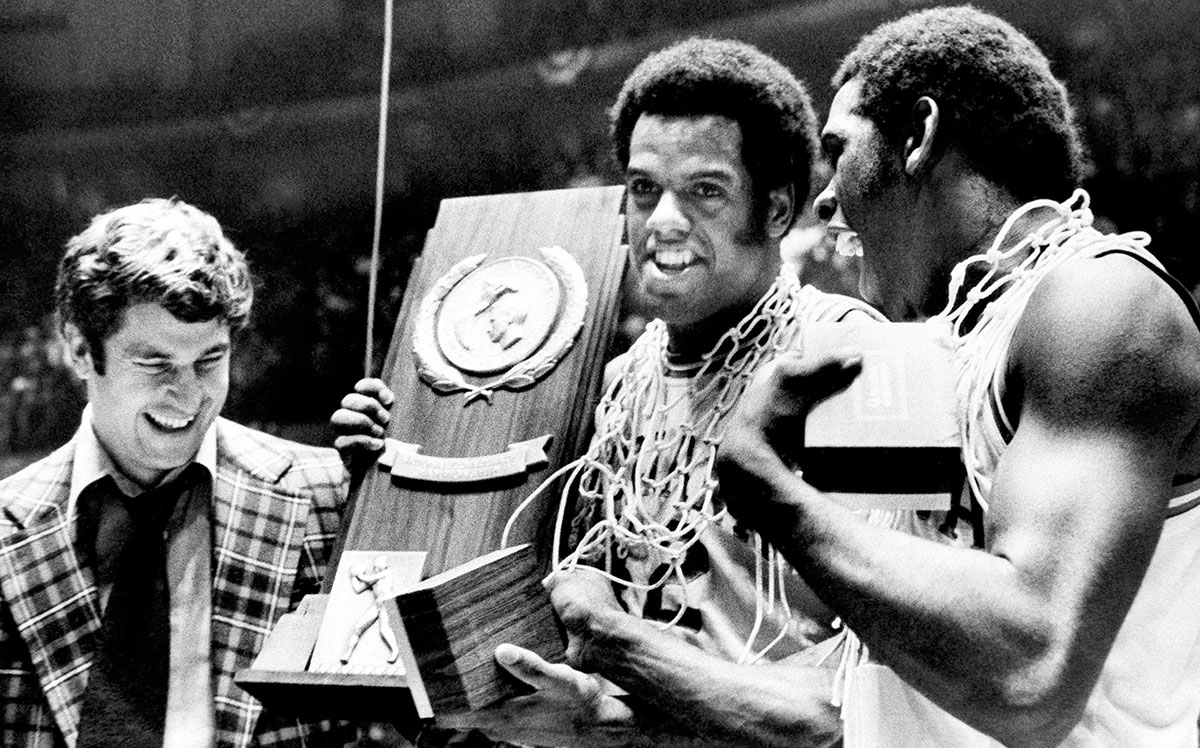
The members of the Indiana University team that won the NCAA Men’s Basketball Tournament in 1976 with a 32-0 record are experiencing a revival as the NCAA Final Four approaches. They have been and will be reunited for multiple group interviews and celebrations, culminating with recognition at halftime of the championship game in Lucas Oil Stadium.
Fifty years ago, when the team was honored at a pep rally in Assembly Hall two days after defeating Michigan for the championship in Philadelphia, coach Bob Knight said, “Take a good look at these guys; you may never see five more like them.”
Fans would be well-advised to take a good look this time around, too. Starters Tom Abernethy, Kent Benson, Quinn Buckner, Scott May and Bobby Wilkerson might never be celebrated together again and for all we know might never be together again. All are in their 70s, squared off against the ultimate undefeated opponent, Father Time, and, besides, reunions never seem to go beyond 50 years, do they?
It does seem there haven’t been five more like these men in college basketball. They were a sturdy, balanced structure without a weak link. No wonder they couldn’t be toppled.
“We played so well together,” Benson says. “We were always striving for excellence. When somebody had a bad night, someone else picked up the slack. We were so in tune with each other.”
Six teams prior to them won a Division I national championship with an undefeated record — San Francisco (1956), North Carolina (1957) and UCLA (1964, 1967, 1972 and 1973). But most of those teams featured soaring talents considered among the all-time greats, such as Bill Russell, Lew Alcindor and Bill Walton.
None of the IU players from 1976 are in the Naismith Hall of Fame, and none were NBA All-Stars, but all had meaningful careers in the league. They also earned significant individual recognition as collegians. All five scored more than 20 points in at least one game that season, and all five found multiple ways to contribute on multiple occasions.
May — the leading scorer with a 23.5 average on 53% shooting — was the consensus national Player of the Year, an Olympian and the second overall draft pick, by Chicago.
Benson, like May, was a first-team All-American and would be drafted first overall the following year by Milwaukee. Buckner, the acknowledged leader, was an Olympian and the seventh overall pick by Milwaukee. He, like May, is in the National Collegiate Basketball Hall of Fame.
Wilkerson was a second-team all-Big Ten selection and the 11th overall pick, by Seattle. And Abernethy — a player whom television commentator Dick Enberg described during the broadcast of the final game as “the kind of kid you don’t notice who just wins games for you” — was selected to the all-Final Four team for his defensive excellence and shooting accuracy. He became a third-round pick of the Lakers and wound up playing five NBA seasons.
Add contributing bench players including senior Jim Crews, who started on IU’s Final Four team as a freshman in 1973, and underclassmen Wayne Radford, Jim Wisman and Rich Valavicius, and you have perhaps the greatest college team of all time.
None of the IU players make that claim, however. Humility was another of their assets.
“I’m not overly hung up with that moniker,” Abernethy says. “When you’re playing, you’re trying to win one game at a time. But 10 years go by and then 20 and all of a sudden it becomes a novelty. It’s so hard to compare abilities and teams.”
“We’re not like the ’72 [Miami] Dolphins,” adds Benson, referring to the members of the most recent NFL team to win a championship with an undefeated record, some of whom share a champagne toast when a team threatening their perfection loses a game late in the season.
“If someone would happen to be undefeated and win a national championship, guess what?” he said. “We’re going to celebrate them.”
If this IU team had an individual star, it was Knight. Just 35 years old at the time, he drove this team through a treacherous season in which it avoided several near mishaps. It had to go to overtime in two of its victories and won five other games by 4 points or less.
He told his players before the season began that they had a chance to make history. He repeated the message at halftime of the final game against Michigan, when they trailed by 6 points. Without Wilkerson, who had been knocked unconscious early in the game, they responded by outscoring the Wolverines 57-33 on their way to an 86-68 victory.
It was, as Benson says, a “flawless” half. But it was years in the making.
“Practice was probably more difficult than games,” Abernethy says. “We had to concentrate on every play in every practice. That’s a hidden fact behind our success, how he had us prepared.”
For Wilkerson, the highlight of the championship experience was not a single game or moment, but rather the multiple-season challenge of being a marked team that was circled on the calendar of every opponent.
“It was how coach Knight taught us perfection and how we picked it up,” Wilkerson says. “We held tight to helping each other. We came together, and coach Knight knew how to adjust. We were disciplined enough to do what he asked us to do.
“We weren’t arrogant,” he says. “We were just confident.”
That confidence was displayed in many ways, including how they responded to verbal challenges.
IU opened the regular season with a 20-point victory over UCLA, which had won the previous season’s championship. After, Bruins all-American forward Richard Washington, who had scored 28 points, proclaimed, “I think we’ll see them again — Philadelphia or wherever — and then I’m pretty sure the outcome will be different.”
The outcome was only slightly different when the two teams met again in the semifinal game of the Final Four. IU won by 14 that time, as Abernethy held Washington to 15 points.
“It’s hard to say any individual is a star because the whole team plays such good defense,” Washington said.
Wilkerson recalls a lighter moment in which a verbal joust was properly addressed. It came in IU’s second NCAA tournament game against second-ranked Marquette, which also had a starting lineup filled with future NBA players and just one regular-season loss. It was one season shy of winning the championship, although it would absorb seven defeats along the way.
“I’ll never forget,” Wilkerson says. “Bo Ellis was laughing at our red and white [striped] warmups. He said, ‘Wilk, where you get those candy-cane pants?’ I said, ‘Bo, you won’t be laughing here pretty soon.’ And he wasn’t. At the end of the game, I said, ‘Bo, you still laughing?’”
IU won by 9 points, although it was more difficult than the score suggested. Buckner and Wilkerson defended Marquette’s guards, Butch Lee and Lloyd Walton, into the oblivion of 5-of-27 shooting performance. Buckner and Wilkerson combined hit half of their 12 shots and passed out 12 assists — 10 more than Lee and Walton.
A somber Ellis scored 9.
“Indiana is a super basketball team,” he said afterward. “They play together so well.”
Any discussion of IU’s ’76 championship team inevitably leads to a comparison to the ’75 team that some believe was superior. That one practically breezed through the regular season, going overtime just once, in the season’s second game at Kansas, and having just one other regular-season scare, a 1-point victory at Purdue.
May fractured his left arm in that game, a blow that likely cost that team a title. He returned three games later for the last 20 seconds of the regular-season finale, his injured arm heavily wrapped. But that team lost to Kentucky, 92-90, one step short of the Final Four. May started but played for just 7 minutes and had more turnovers (3) than points (2).
IU had defeated Kentucky by 24 points early in the regular season. It seems May at full strength could have made up more than a 2-point deficit in the tournament game. Whether or not the ’75 team, which included future pros Steve Green and John Laskowski, was superior to the ’76 team, can be debated. It might have been, but the improvement each of the returning players made over the following year shouldn’t be discounted.
It doesn’t matter now. Nor does it matter what the ’76 starters could have earned had they played in today’s era of NIL payments. With mediocre college basketball players being paid hundreds of thousands of dollars per season now, imagine what members of an undefeated championship team that generated millions of dollars for others would be paid.
Abernethy joked about that when he received the gaudy ring given to the ’76 players during a halftime ceremony when IU played Oregon earlier this season, one far more expensive than what they received 50 years ago.
“They gave us these amazing rings, almost like when you win an NBA championship,” Abernethy says. “In my mind I’m thinking these are diamonds and maybe these are worth $3 million. When I went out on the court [Athletic Director Scott] Dolson and the [university] president were there. I said, ‘Finally, I get my NIL with these rings. These are worth millions, aren’t they?’”
Not quite. But that’s OK. Fifty years of happy memories are priceless.•
__________
Montieth, an Indianapolis native, is a longtime newspaper reporter and freelance writer. He is the author of three books: “Passion Play: Coach Gene Keady and the Purdue Boilermakers,” “Reborn: The Pacers and the Return of Pro Basketball to Indianapolis,” and “Extra Innings: My Life in Baseball,” with former Indianapolis Indians President Max Schumacher.
Please enable JavaScript to view this content.
I’ve heard the boomers claim that IU used to be good at basketball – guess they are telling the truch.
*truth
Indiana’s worst enemy in basketball has been Indiana the last 2 decades. Just a base level of competency and that program will be back in the tournament and possibly more consistently.
Ironically, its Quinn Buckner and his buddies that gave Woodson another year full of wasted NIL and ended up causing Dusty May to end up at Michigan. It can’t be said enough. For everything the Knight era gave Indiana, the old guard and its fans have been the primary reason the program has struggled to move forward. Some of them still feel if it can’t be done their way, they would prefer to tear it down.
Awesome team and great article to remember what IU Basketball was all about in that era. Team work, hard work, and humility.