
Subscriber Benefit
As a subscriber you can listen to articles at work, in the car, or while you work out. Subscribe Now Injuries are as prevalent in sports as betting lines, and every college program and professional franchise suffers because of them. A team just isn’t the same when a key player goes down, no matter how many times you close your eyes and recite the mantra, “Next man up.”
Pacers fans know that better than most, having witnessed so many 20-something-year-old star players suffer injuries that prematurely ended or severely disrupted their careers. So many that it seems fair to wonder what the franchise did to the basketball gods to deserve such a cruel fate. Four players, three of them multiple-year All-Stars, have been lost for large swaths of a season after suffering injuries without even touching another human. Three others had careers harshly abbreviated by knees that wore out too soon.
Put those seven together in their prime with healthy legs and they could contend for a championship: Clark Kellogg, Steve Stipanovich, Al Harrington, Danny Granger, Paul George, Victor Oladipo and, of course … Tyrese Haliburton, who earned worldwide sympathy after falling face-down with a ruptured Achilles in Game 7 of the NBA Finals in Oklahoma City. The sight of him crying out in anguish and pounding the floor with his right fist will live forever in the minds of Pacers fans.
Haliburton had already made three 3-pointers in the game’s first five minutes and appeared poised for yet another memorable playoff performance. What would have happened had he been able to finish the game we’ll never know, but the Pacers’ hopes for their first NBA championship were ruined. His teammates hung in for the rest of the half but ultimately collapsed under the burden of the Thunder’s talent and their own dejection.
They weren’t alone in their thoughts.
“My heart sank when I saw Tyrese go down,” said Kellogg, who was watching the game with 11 friends at a sports bar in Wisconsin while on a four-day golf trip. “It was a devastating injury. I was deflated. He’s such a terrific player and galvanizing force.”
Kellogg, Stipanovich and Granger didn’t experience specific injuries; they had the misfortune of being stuck with knees with early expiration dates.
Kellogg, who finished second to Terry Cummings in the voting for Rookie of the Year in the 1982-1983 season when he averaged 20.1 points and 10.6 rebounds, played just two more complete seasons after that and then 23 games over the next two seasons. Three arthroscopic surgeries couldn’t fix the cartilage damage from the wear and tear, and he retired at age 25 in 1987.
“Just one of those unfortunate circumstances,” he said at the press conference.
Stipanovich, a consistent 13-point scorer, followed a year later, retiring after five seasons at age 27 with a degenerative condition in his left knee.
The only good to come out of those losses was that they contributed to losing records that put the Pacers in position to select future Rookie of the Year Chuck Person, future Naismith Hall of Famer Reggie Miller and Rik Smits, who became the franchise’s second all-time leading scorer.
Granger dropped to the Pacers with the 17th pick in the 2005 draft because of concerns about his knees, but he got through seven seasons relatively unscathed. He was a very good player on some very mediocre teams—his peak coming when he earned a spot in the All-Star game in 2008, a season in which he averaged 25.8 points and hit 40% of his 3-pointers for a team that finished 36-46.
The cruel irony was that his knees gave out just as the Pacers were finally becoming a contending team. He played in just five games in 2012-2013 when they lost a seven-game series to Miami in the conference finals and in 29 games the following season when they made a return trip.
He was 28 when he played his last meaningful season and 31 when he retired in 2015 after brief stints with the Clippers and Miami.
‘A different career’
The freakiest injuries are those that occur out of thin air.
Harrington, drafted in the first round out of high school in 1998, was in his fourth season but still just 21 years old in January 2002. He was averaging 13.1 points and 6.3 rebounds for a young and blossoming team and a candidate for Sixth Man of the Year. But then came a night in Boston, when he ran along the baseline from right to left to pop out to the wing for a pass. His right knee buckled. He had torn his ACL.
He would go on to play 16 seasons but believes his career was never the same after that.
“I 1,000% believe that,” he once said. “That was the biggest hiccup in my career.
“I was really coming into my own. I definitely feel if I didn’t tear my ACL I would have had a different career.”
It’s impossible to predict how things would have been different for the Pacers had he stayed healthy. They made a seven-player trade with Chicago three weeks later, one that brought forward Ron Artest from the Bulls. By the time Harrington returned the following season, Artest was entrenched as a starter and armed with a contract extension.
Harrington accepted a backup role for two more seasons, including the 61-win campaign of 2003-2004, but had grown frustrated with his role by then. He asked to be traded and was—to Atlanta.
George was on track to become the most decorated Pacer of all after the 2013-2014 season. He had just turned 24 when the season ended and already was a veteran of two All-Star games as well as third-team all-NBA and first-team all-defense selections. He was being groomed to play on the U.S. Olympic team but suffered a horrific injury on Aug. 1 when he crashed into a support that was too close to the basket in a Team USA scrimmage and fractured the tibia and fibula in his right leg.
LeBron James tweeted, “Made me immediately sick to my stomach!!”
George made the comeback, playing the final six games the following season and then two more seasons with Indy. He became an All-Star again, but his injury set off a chain reaction. The Pacers were no longer a contender without him, so 35-year-old forward David West, desperate to win a championship before retiring, opted out of his contract in 2015. It then made sense to trade two-time All-Star center Roy Hibbert, whose lumbering style of play had become archaic, and build the team around George. He wasn’t cut out for a leadership role, however, and the team was stuck in neutral: 42-40 in his final season.
With no warning, he asked for a trade via his agent in the summer of 2017. Team President Kevin Pritchard called it a “sucker punch.” Fans could have simply retweeted LeBron’s reaction to the injury, because it made them immediately sick to their stomachs, too.
‘A little speed bump’
It worked out, though, For a while, anyway. Oklahoma City sent the Pacers two future all-stars, Victor Oladipo and Domantas Sabonis, for George. Both excelled. Oladipo, in particular, became a fan favorite. He was an All-Star in his first Pacer season in 2017-2018, every bit as productive as George had been and as popular as any NBA Pacer this side of Reggie Miller.
“It’s been a great year, a great year,” he said at a press conference in his honor. “I’m just humbled to be part of this organization and this program. I’ve come a long way. Just amazing how things change in a year.”
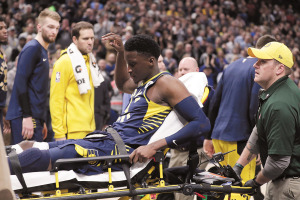
Amazing, indeed. But that works both ways. A year later, Oladipo was rehabbing a torn quadriceps muscle in his right knee that he shredded merely by jumping to intercept a floor-length pass in a game against Toronto on Jan. 23, 2019. He had sat out 11 games earlier in the season with a sore knee and wondered if that somehow contributed to his freak injury, but there was no way to know.
Oladipo returned to play 36 games the following season but was traded after nine games in 2022-2023 when negotiations for a contract extension fell through. He has since played sparingly with Houston and Miami but faced continual setbacks. He sat out the previous two seasons while rehabbing but still declares his intent to return.
And now Haliburton. Oladipo and George can relate to his plight.
George, in a recent podcast, said Haliburton’s injury will “shape the future of Indiana.” His own injury certainly did. But he also believed he became a better player because of his absence.
“You sit out, you become a student of the game,” he said.
Oladipo, who made similar comments after his forced layoff, tweeted encouragement for Haliburton the night of the injury: “Rest up Hali bro this will make you stronger.”
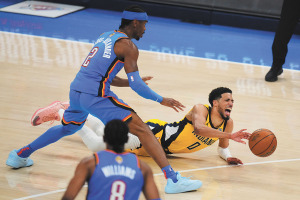
Haliburton is likely to miss all of next season, but he’s also expected to return to peak form, or close to it. The best that can come from it now is that some of the other Pacers will benefit from the additional playing time and opportunities made possible by his absence. The current team might be deep enough to reach the playoffs again next season and young enough to rebuild another contender after Haliburton returns.
“He’s still very much in the early stage of his career,” Kellogg said. “He’ll miss being out there, but in a year, as long as that sounds, the way time moves, that’s a little speed bump compared to what his career looks like it will be.
“You have to adjust to losing a leader and a player of that caliber. It’s not just the numbers, it’s the other stuff—his energy, his enthusiasm, the confidence he brings to his teammates in addition to what he does statistically.”
Those adjustments will be numerous. Probably painful at times, too. But nothing new for the Pacers.•
__________
Montieth, an Indianapolis native, is a longtime newspaper reporter and freelance writer. He is the author of three books: “Passion Play: Coach Gene Keady and the Purdue Boilermakers,” “Reborn: The Pacers and the Return of Pro Basketball to Indianapolis,” and “Extra Innings: My Life in Baseball.”
Please enable JavaScript to view this content.
Editor's note: You can comment on IBJ stories by signing in to your IBJ account. If you have not registered, please sign up for a free account now. Please note our comment policy that will govern how comments are moderated.