
Subscriber Benefit
As a subscriber you can listen to articles at work, in the car, or while you work out. Subscribe Now
The Pacers have participated in the NBA’s favorite game show 13 times since it debuted in 1985, and what do they have to show for it?
One lousy win. A big one, mind you, but just one occasion when they left with more than they came with. Just one time when they won a meaningfully better draft pick than they deserved based on their regular season record.
Welcome to the NBA Draft Lottery.
This time around, when ping-pong balls in a hopper determine the fate of league franchises — and perhaps the employment of coaches and general managers — for years to come, they’re just hoping to get what they deserve. The Pacers have “earned” a 14% chance of landing the No. 1 pick and a 52.1% chance of landing one of the top four picks in the 2026 draft on Sunday by finishing with the worst record in franchise history, 19-61.
All it took to accomplish that was Tyrese Haliburton’s torn Achilles in Game 7 of last season’s NBA Finals at Oklahoma City, which kept him out for the entirety of this season, and a training room full of lesser injuries to key contributors. Pacer players missed 429 games due to injury this season, which led to 47 different starting lineups, which led to the second-worst record in the league (behind Washington), which will have a lot of people watching anxiously at 3 p.m. on Sunday (check local listings).
It promises to be one of the most dramatic moments in franchise history, fraught with tension and significance. The Blue and Gold either depart Chicago with the bounty of one of the top four picks in the draft, which could bring a player who, when plugged into the roster that nearly won the championship last year, makes them an even greater contender, or they go home empty-handed.
That would qualify as a tough blow. Sure, they could devote the money that would have gone to their draft pick as part of a deal to acquire a veteran free agent who might bring immediate help, even more help than a teenage rookie could provide. But the most desirable outcome by far is to land a young player with the potential to develop into an All-Star or superstar.
Otherwise, what was the point of going 19-63? Fans, still giddy over the thrilling run to the 2025 Finals, were rooting for losses once the season turned irreversibly south, hoping to improve the odds of landing a high draft pick. To walk away with nothing would make all the losing seem pointless.
A trade like no other
The Pacers’ state of uncertainty is the result of a unique February trade they made with the Los Angeles Clippers. One can only imagine the negotiations that led to it. Desperate for a bona-fide center, President of Basketball Operations Kevin Pritchard sent two of his former first-round draft selections, Bennedict Mathurin and Isaiah Jackson, to obtain Ivica Zubac, a solid but less-than-elite 29-year-old 7-footer. He added this year’s first-round pick to the deal with a major asterisk attached. If it winds up falling between the fifth and ninth selection, the Clippers get it. If the lottery gods smile upon the Pacers and they get one of the top four picks, they keep it.
At 52.1%, it’s a virtual coin flip.
With one exception, the Pacers have always emerged from the lottery show with a draft pick within one spot of where they would have drafted based on their record. They will gladly settle for such a fate this year. It would be the worst time to suffer a stroke of bad luck. But, again, it’s a coin flip, and the Pacers know what can happen then. They were involved in one of those with Houston in 1983 for the first pick in the draft, with the grand prize of Ralph Sampson waiting in the wings.
Commissioner Larry O’Brien conducted a preliminary coin flip to determine who got to make the call. Houston won that and called heads, just as Pacers owner Herb Simon said he would have done. O’Brien then tossed a 100-year-old silver dollar into the air, and it landed heads up.
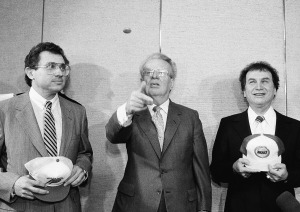
“I didn’t expect to lose,” Simon said. “I’ve never lost like this before.”
(Perhaps the Pacers should have sent Slick Leonard to participate in the coin flip. He once settled a negotiation for his salary as a broadcaster with a coin flip and won it. Asked about it later, he said, “I wasn’t going to lose that one.” If anyone could influence such an event, it was him.)
The Rockets took Sampson, and the Pacers settled for Steve Stipanovich. Sampson played in the NBA All-Star Game each of his first four seasons, including in 1985 when he was voted Most Valuable Player of the game in Indianapolis. Injuries cut short his career, but he still was inducted into the Naismith Hall of Fame. Stipanovich was merely steady and serviceable but also had an injury-shortened career.
The NBA initiated a lottery system in 1985 with Commissioner David Stern drawing cards bearing team logos out of a hopper — the league’s initial attempt to prevent tanking. The Pacers finished with the second-worst record that year and wound up with the second pick. They took Wayman Tisdale, who seemed the obvious choice at the time. He was good — not great — and they traded him away during his third season. New York got the showcase prize with the No. 1 pick, Patrick Ewing. He became an 11-time All-Star and Hall of Famer.
Worth noting, however: Just as the Rockets never won a title with Sampson, the Knicks never won one with Ewing.
Also worth noting: Golden State had finished with the worst record in the league that season but wound up with the seventh overall pick. The consensus was that it had been robbed by the new process, but the team took Chris Mullin, who went on to have a Hall of Fame career for the Warriors. The lottery outcome guarantees nothing.
Perhaps those early incidents of bad luck for the Pacers were the result of karma having its say after the franchise had so much good luck in the ABA. That league was focused on mere survival, so if a franchise could sign a great college player it was free to do so regardless of where it fell in the draft order. That’s how the Pacers were allowed to sign Purdue All-American Rick Mount after winning the championship in 1970 and how they were able to sign future Naismith Hall of Famer George McGinnis after finishing with the league’s best record in 1971.
Those “gifts,” combined with landing two other future Hall of Famers —Roger Brown out of a factory in Dayton and Mel Daniels for $100,000 — amounted to a mother lode of good fortune. Maybe a correction was in order.
Smits happens
Fate, however, was back in the Pacers’ corner again in 1988. The Pacers had finished 38-44 in the previous season, best of all the non-playoff teams and even better than one Western Conference team that qualified for the postseason. Fomer Rookie of the Year Chuck Person had played two seasons, and Reggie Miller was coming off a solid rookie year, so a nucleus was forming. The Pacers added to it when they won the second pick in the draft despite having tied for the eighth-worst record.
In that year’s lottery format, the first three picks were determined by Stern drawing envelopes containing team logos out of a hopper while the remaining lottery picks were based on record. The Pacers could have wound up with the first, second, third or seventh pick, so getting No. 2 was a major victory.
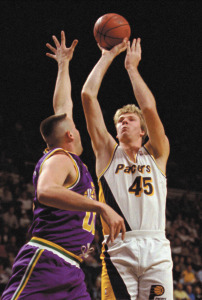
“We needed a break, and we got one,” General Manager Donnie Walsh said at the time.
Walsh fielded trade offers for the pick but took Rik Smits, who played 12 seasons and still ranks as the franchise’s second all-time leading scorer while making one All-Star Game appearance.
Danning Manning went first to the Clippers. He became a two-time All-Star. But his career was curtailed by a knee injury, and he wound up playing for seven teams. That’s another risk of the draft: An injury early in a career can turn a great pick into a mistake, through nobody’s fault.
Had the Pacers not been so lucky that year, it’s unlikely they would have made five runs to the conference finals between 1994 and 2000, capped by a trip to the Finals. Their options with the seventh pick would have been much slimmer, with none better (for them) than Smits. He was never their best player, just always crucial.
Landing a top-four pick this year feels equally crucial to the Pacers’ playoff fate. They have pieces but probably need one more to contend for a title. And it would only be fair, wouldn’t it, for them to have some good luck given their bad breaks of the past 10 years?
Paul George was on track to become one of the greatest players in franchise history when he broke his leg in a summertime exhibition game for Team USA in 2014. Victor Oladipo replaced George as the “this is my city” guy, an overwhelming fan favorite who seemed destined for a long run with the franchise. He suffered a torn quad muscle in a game in 2019 and was never the same again. Last year, Haliburton produced about as many playoff highlights in one season as Miller had in an 18-year career and appeared headed toward delivering the ultimate one, a Game 7 victory on the road, before going down.
Three flukey injuries. Difficult to explain and incredibly cruel.
Maybe a makeup call comes on Sunday. T.J. McConnell will represent the Pacers for the lottery proceedings. He knows something about overcoming odds, having successfully transferred from mid-major Duquesne to national power Arizona and then carving out an NBA career that’s still going strong after 11 seasons despite being undrafted.
This assignment should be a breeze. He won’t have to overcome odds. He’ll just need to summon the strength of the greatest asset the Pacers have ever had in a draft lottery — all 52.1% of it.•
__________
Montieth, an Indianapolis native, is a longtime newspaper reporter and freelance writer. He is the author of three books: “Passion Play: Coach Gene Keady and the Purdue Boilermakers,” “Reborn: The Pacers and the Return of Pro Basketball to Indianapolis,” and “Extra Innings: My Life in Baseball,” with former Indianapolis Indians President Max Schumacher.
Please enable JavaScript to view this content.
Editor's note: You can comment on IBJ stories by signing in to your IBJ account. If you have not registered, please sign up for a free account now. Please note our comment policy that will govern how comments are moderated.