
Subscriber Benefit
As a subscriber you can listen to articles at work, in the car, or while you work out. Subscribe Now Judi Warren remembers the exact moment the landscape shifted for the girls who played basketball in Warsaw. All it took was a state championship.
It happened on Feb. 28, 1976, when she led her high school to the first tournament title sanctioned by the IHSAA. To that point, the girls in Warsaw High School’s intramural program had unsuccessfully lobbied for something resembling equal access to the gymnasium for practice after school, only to be told by the school’s athletic director, who also served as the boys’ coach, to come back when they could fill the gym and cover their own expenses. Like the boys did.
That night at the pep rally celebrating the championship, with the school’s gymnasium bleachers packed, he realized the time had come. “I see you can fill the gym, so we’ll have to talk about equal gym time,” he said.
“That might have been the brightest moment of it all,” Warren says today.
The WNBA will conduct its annual All-Star Game Saturday in Indianapolis, and the gym will be full, so to speak. Gainbridge Fieldhouse not only sold out after tickets went on sale April 29, but it did so in just seven hours. That as well as anything serves as a marker for the progress the women’s game has made over the past 50 years as it’s grown from a scholastic intramural sport that drew snickers from people who didn’t think women should sweat to a mainstream professional enterprise that has captured the interest of even the men who play or played the game at a high level.
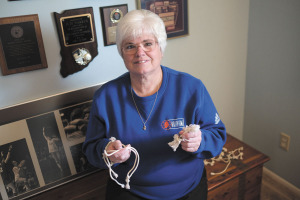
Warren, the first of the 50 IndyStar Miss Basketball selections to date, will be among the group returning to Indianapolis to participate in the weekend’s festivities. They form a human timeline that also measures the progression of their game. The early ones just happened to come along too soon.
Warren had to play basketball within the confines of the Girls Athletic Association until her senior season at Warsaw. Their practices were conducted in the evening, after all the boys teams were finished. They didn’t have uniforms, so they wore T-shirts with self-adhered numbers. They only played about 10 games and had to carpool to those at other schools rather than take a school bus.
“There was nothing,” she said. “After we won state, they kind of said, ‘OK, you deserve a little something.’”
The pioneers
Jody Beerman, the 1983 Miss Basketball from Heritage High School, came along late enough to get a college scholarship and have a professional opportunity. She played at Central Michigan and then one summer overseas. An Ame rican professional league didn’t yet exist, so opportunities were limited. The only way to stay in basketball long term was coaching, so she led Lawrence North’s girls team for 12 years and coached the Indiana All-Star team in 2004. She’s now an elementary teacher. One born too soon in the basketball world.
“I missed it by a few years,” she said. “[Playing in the WNBA] would have been so much fun, but I’m very happy for all these women that have the opportunity to play in front of so many people.”
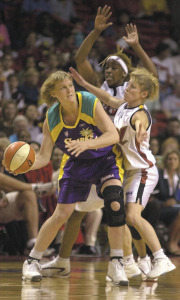
Vicki Hall, Miss Basketball in 1988 from Brebeuf Preparatory School, was the national player of the year and had a standout career at Texas. She caught on with the American Basketball League in the 1990s and then briefly with the WNBA, including 13 games for the Fever in 2001, but she was 31 years old by then. She continued playing overseas and then coached for many years, including stints as the head coach at Indiana State and as an assistant with the Fever a few years ago.
Her early path met with resistance. Orchard Elementary did not have a fifth-grade girls basketball team. The coach of the boys team wouldn’t let her play with that group, so she had to join the eighth-grade girls team.
“It turned out OK, but there were other problems that come with that,” she said.
Hall wanted to play soccer, too, but Orchard didn’t have a girls team for that sport. She was allowed to play with the boys on that team, but the coach refused to give her a uniform. She had to play in her phys ed class gear.
Now a registered investment adviser in Indy, she has witnessed firsthand the explosion Caitlin Clark set off for the Fever.
“When I was coaching with the Fever, we couldn’t give a ticket away,” she said. “She’s really changed it for the Fever, 100%. Everybody gives her a hard time, but you have to give credit where credit is due.”
Jennifer Jacoby, the 1991 Miss Basketball out of Rossville High School, started 82 games for Purdue and was able to play two seasons in the ABL, which folded after the WNBA muscled it out of the way with its NBA backing. She declined invitations to play overseas, figuring she had already done enough damage to her knees. She’s had two anterior cruciate ligament repairs, seven arthroscopic surgeries and one knee replacement.
She experienced the game’s growth firsthand but never imagined it would become this.
“Crazy, crazy, crazy,” said Jacoby, who now coaches Rossville’s girls team. “I think it’s awesome. I’m not from the NIL era—that stinks—but I think it’s great. There’s a long way to go, but with Caitlin and Paige [Bueckers] and all these kids coming out, they’re making everyone excited about [the women’s game].”
Male support
That includes established notable figures from the men’s side of the game—people you might assume would not be impressed with women playing basketball, even at the WNBA level.
Pacers star Tyrese Haliburton is a regular at Fever games, sitting in the front row and wearing team merchandise. He and Clark have become close friends. It hasn’t been unusual over the years for Pacers to attend Fever games, particularly when their seasons overlap, but Haliburton has taken it to another level.
Pacers coach Rick Carlisle has declared himself a “big follower” of the WNBA and appreciates their more fundamental style of play.
“There are things that can be learned by NBA staffs and players watching the W because the dynamics of their game are a little different,” Carlisle once said. “The footwork elements of it are very, very high level. And you know, the personalities, they are coming at you all the time. It’s very fun. It’s very fun to follow.”
Pacers legend Reggie Miller got a head start learning respect for the women’s game, having had an older sister down the hall from his upstairs bedroom in Riverside, California, who happened to be the greatest female player of her generation. Reggie and Cheryl battled each other on the concrete slab in their backyard, and Reggie worked out with the girls team their father coached.
Reggie voiced support for the Fever during their humble beginnings and got his start as a broadcaster by working their games. He called today’s WNBA players “straight ballers.”
Having a family connection as Miller did is the surest way to learn to appreciate the women’s game. Larry Humes, who was Indiana’s Mr. Basketball in 1962 and a Division II All-American at the University of Evansville, coached his daughter in middle school at St. Matthews. She went on to play two years at Cathedral High School before shifting her focus to softball. He also coached a granddaughter.
He’s followed the Fever from their inception. He attended many games years ago and watches nearly every one on television now.
“Women’s basketball is fundamentally better than the guys,” he said. “Their game is more like it used to be played in the old days. It was more of a team sport back then, because you didn’t have the outstanding players you have today. Today, you have players, guys and girls, who are unbelievable in what they can do.”
Rick Mount—Mr. Basketball in 1966, a three-time All-America selection at Purdue and a five-year veteran of the ABA—watches the Fever just as closely. His interest, like that of the majority of fans who began filling Gainbridge last year, is based almost solely on admiration for Clark. Mount, a legendary long-distance shooter who graced the cover of Sports Illustrated as a high school senior, is drawn to star power and has been following Clark since she became nationally recognized while playing collegiately at Iowa.
“She’s just got something about her,” said Mount, who has two granddaughters playing at Lebanon High School. “Some players got it. She’s got a lot of moxie. She can shoot it. She can handle it. She’s always been a winner. There’s something about some players; they stick out. I don’t know what it is. People want to go see you play. You really can’t put a finger on it.
“She’s like Elvis Presley. She’s an attraction.”
An attraction who can fill arenas. But forerunners like Warren, Beerman, Hall and Jacoby put in the sweat needed to pave the way.•
__________
Montieth, an Indianapolis native, is a longtime newspaper reporter and freelance writer. He is the author of three books: “Passion Play: Coach Gene Keady and the Purdue Boilermakers,” “Reborn: The Pacers and the Return of Pro Basketball to Indianapolis,” and “Extra Innings: My Life in Baseball,” with former Indianapolis Indians President Max Schumacher.
Please enable JavaScript to view this content.
Editor's note: You can comment on IBJ stories by signing in to your IBJ account. If you have not registered, please sign up for a free account now. Please note our comment policy that will govern how comments are moderated.