
Subscriber Benefit
As a subscriber you can listen to articles at work, in the car, or while you work out. Subscribe Now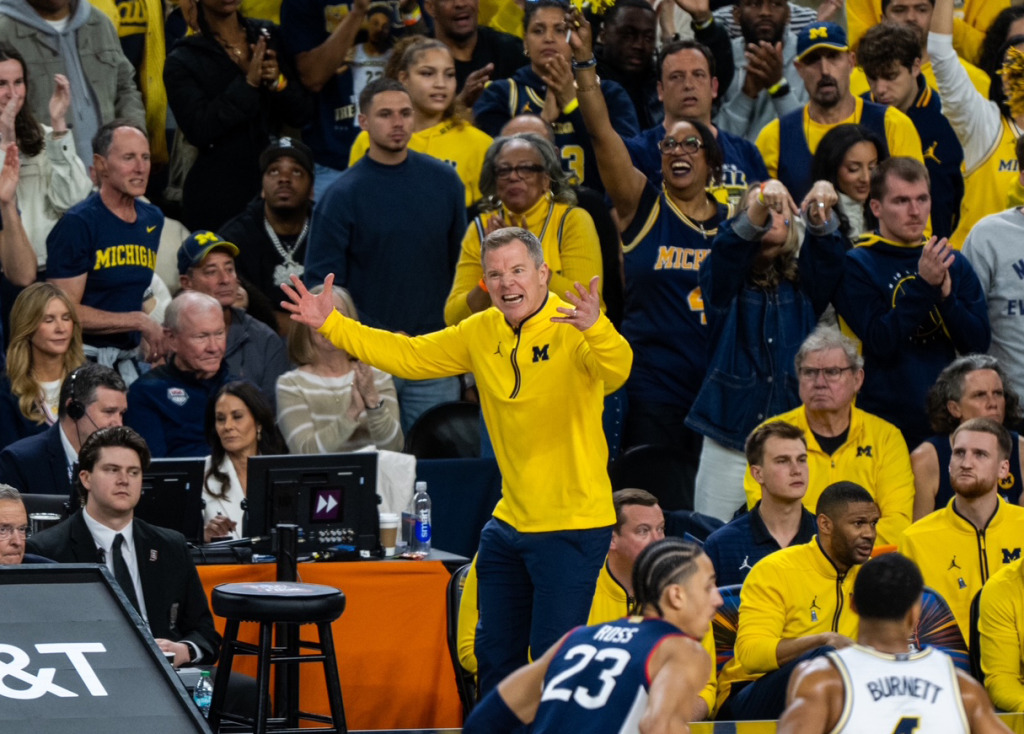
Click here to return to The Tip-Off home page.
Like it or not, this is likely the future of college basketball. Transient teams with shallow roots microwaving championships.
Michigan, with an all-transfer starting lineup and a coach who has mastered the new way of acquiring talent — in questionable fashion in the opinion of some — won it all Monday night. It was ranked first in the country for just one week during the regular season and didn’t win its conference tournament, but it won when it mattered most.
It wasn’t pretty, it wasn’t efficient, and it wasn’t particularly dramatic for neutral observers. But it happened. And don’t think it won’t happen again.
On a night when Indiana’s undefeated championship team of 1976 was brought to the media before the game and presented to the 70,720 fans at Lucas Oil Stadium at halftime, the contrast between the then and now of college basketball could not have been more blatant.
Three of IU’s starters came out of Indiana and the other two came from neighboring states. Four were seniors and one a junior, upperclassmen who overcame adversity and emerged from a structured system that honed and melded their talents.
Michigan’s starters were plucked from the portal, purchased with funds from a major university’s endless bounty. Four of them were new to the team this season, including Elliot Cadeau, who scored 19 points and earned Final Four MVP honors. He played at North Carolina last season. Not a single one of the starters grew up in Michigan. And not a single Michigan fan cares.
The team had no history heading into the season, so it began as an unknown commodity. It was ranked seventh at first, got to No, 1 for a week in February before losing to Duke, and then fell back to third the rest of the way.
Scott May, the national player of the year on Indiana’s ’76 team, gave a succinct analysis before the game. He predicted a Michigan victory and said he admired its talent at both ends of the court, but added, “there’s something about UConn.”
And there was. Danny Hurley’s team, facing an opponent he called “incredibly imposing physically,” managed to stay within reach of its third championship in the past four seasons until the final minute, when it caved under Michigan’s defensive pressure. The Wolverines shot 38% from the field, including 13% from three-point range, were outrebounded 46-39, gave up 13 more field goal attempts than it got, but won by attacking the rim and drawing fouls. It outscored Connecticut 13 points at the foul line.
The title provided a Hollywood ending to Michigan coach Dusty May’s dramatic rise to the peak of the coaching ranks. May is a self-deprecating sort with the kind of humility you expect from someone who grew up in southern Indiana and clawed his way into the coaching profession from the lowly platform of a student manager in Bob Knight’s program from 1996-2000. His first head coaching job came in 2018 at Florida Atlantic, where he inspired an immediate turnaround from irrelevancy and prodded it to the Final Four in 2023. He took over at Michigan a year later and voila — here he is, a championship coach in his second season.
He has been criticized for his relentless use of the portal. Two of his starters, Morez Johnson (Illinois) and Aday Mara (UCLA), came from other Big Ten programs, which didn’t earn him friends within the conference’s coaching brethren.
It is probably telling that he earned the Coach of the Year honor from the Big Ten media for winning the regular season conference title but not from his fellow coaches. Nebraska’s Fred Hoiberg won that vote.
May defended his approach before Saturday’s semifinal games.
“Look, I know this is going to set off a Twitter firestorm, but I think we all are better in certain situations than others,” he said. “There’s an environment that’s right for me. There’s an environment that’s right for you. Sometimes you don’t choose the right environment from the beginning or sometimes as people we change and we need something different, for a number of reasons.”
What’s impossible to doubt is the respect he has earned from his players. His positive demeanor and relentless devotion to detail has won them over, and will continue to win over recruits, wherever they come from.
“When we tell you Coach Dusty is the same person all the time, he really is,” Michigan reserve Trey McKinney said. “That’s the thing I love the most about him. That makes you put all your trust into a coach. I think that’s why we go so hard as a group for him. We know what he means to us. He’s a players’ coach.”
Much has been said and written about IU’s role in this Final Four. Or, rather, its non-role. How it could have hired May after former coach Mike Woodson’s third season but didn’t. How it might have been able to successfully recruit Greenfield’s Braylon Mullins, who just completed an intriguing freshman season with UConn, if it had hired May.
That’s all convenient hindsight.
Purdue, however, played a more tangible part in Michigan’s title run. Its 80-72 victory over the Wolverines in the championship game of the Big Ten tournament on March 15 provided a humbling blow that forced them to regroup.
“We knew we had lost our edge a little bit,” May said.
“It gave us a chance to take a deep breath, recalibrate, refocus and also reflect on what we did when we were at our best and what we were thinking about and what we were focused on. It was a reboot.”
Now Mullins, the Greenfield native who had become a tournament darling, faces one.
The Greenfield native had hit dramatic three-pointers in UConn’s victory over Duke to get to the Final Four and then over Illinois to get to the championship game. He didn’t finish the season as planned, however, hitting just 4-of-17 shots, including 3-of-10 three-pointers, and scoring 11 points without getting to the free throw line.
He wasn’t alone in his shooting misery. The Huskies hit just 31% of their field goals, including 27% of their threes.
“We did a great job with our defense [Michigan shot 38 percent and hit just 2-of-15 threes], we just couldn’t hit enough shots,” a red-eyed Mullins said in the locker room. “They have a great defense. You’ve got to make harder shots and those harder shots we couldn’t make tonight.”
UConn didn’t win the Big East regular season title or conference tournament, finishing second to St. John’s in each instance. It finished second in the ultimate tournament as well but won’t apologize for its runner-up finish and 34-6 record.
“We didn’t accomplish our three goals … but you can’t deny how great we were,” Mullins said. “I mean 34-6, that’s special for anybody. Coach said it earlier, you maximized your season, you got to the very last game. Just to be part of that … .”
Mullins now has a decision to make. He was projected as a mid-first-round pick in the NBA draft during the regular season and didn’t damage his status in the NCAA tournament despite Monday’s struggles. The logical thing to do is enter the draft and work out for teams to gain feedback and then decide whether to return for a sophomore season.
He’ll wait and see.
“I’m still in the moment here,” he said. “I have no clue what my future holds. I guess we’ll figure that out in the following weeks.”•
Montieth, an Indianapolis native, is a longtime newspaper reporter and freelance writer. He is the author of three books: “Passion Play: Coach Gene Keady and the Purdue Boilermakers,” “Reborn: The Pacers and the Return of Pro Basketball to Indianapolis,” and “Extra Innings: My Life in Baseball,” with former Indianapolis Indians President Max Schumacher.
Please enable JavaScript to view this content.
I can’t believe no one at IU thought to hire May a couple years ago…. (LOL)
Why would Mullins want to attend IU. They can’t even get into the tournament let alone compete. You people are delusional. Keep expecting Brad Stevens to come back begging for a job.
It was fun to watch another Big Ten school win a title with a coach who, at one point, would have loved to coach at IU… and now probably wouldn’t even stop in Bloomington on his drive home to Greene County.
There’s a reason that IU can’t get the top tier basketball coaches or players to come there and deal with that fanbase. Full credit to their AD for the Cignetti hire, which he nailed, but just wait until the AD moves on and Cignetti retires and the IU fanbase starts the same nonsense as Nebraska, which started firing coaches for “only” going 9-3 and now is nowhere.