
Subscriber Benefit
As a subscriber you can listen to articles at work, in the car, or while you work out. Subscribe NowClick here to return to The Tip-Off home page.
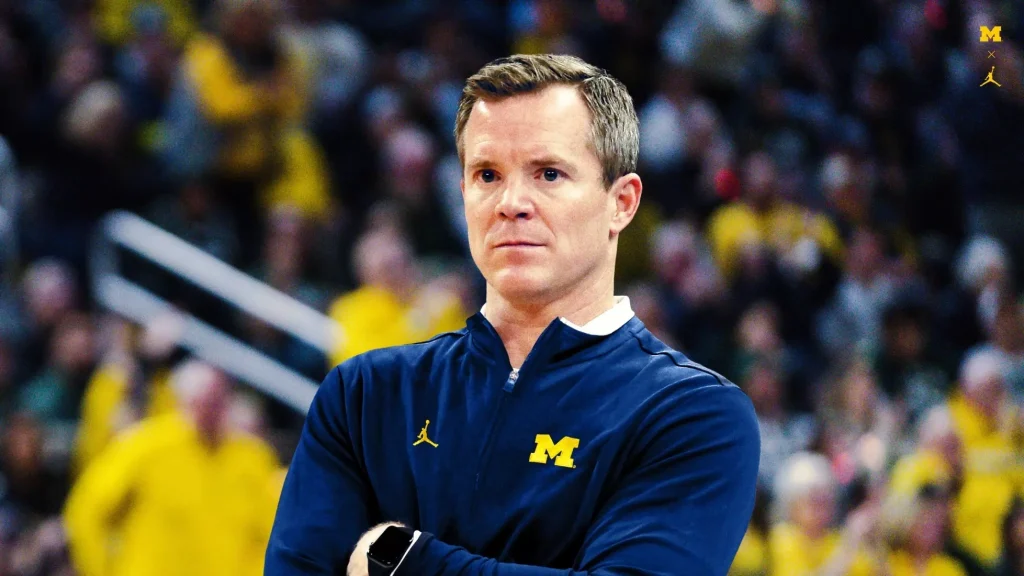
In Sunday’s press conference, UConn head coach Dan Hurley joked about how well Dusty May is aging. He laughed, saying the 49-year-old Michigan head coach looked to be in his early 40s, attributing May’s full head of hair to that perception.
Before May addressed the media, some in the room were lightheartedly wondering about his skin care routine or what shampoo he uses. He climbed the dais as that speculation carried on.
“I hear the topic of conversation was my hair and my age,” May said. “Well, when God gives you the raspy voice and height and lack of vertical jump, He’s got to bless you with something.”
That’s not all May has been blessed with, and it certainly isn’t one of the driving factors that’s propelled him to being one of the best coaches in the sport, now with the chance to win his first national title Monday night. That success can be attributed to May’s greatest gift: perspective.
In this ever-changing landscape of college basketball, with new rosters needing to be constructed each year and NIL changing the power dynamics, it’s easy to compare one program to another, especially as a coach. Yes, Michigan had the second ranked transfer portal class last summer according to 247Sports, but it wasn’t so much a result of May chasing the most valuable recruits; he was chasing fits — schematically and personally.
Those fits also happened to be elite players.
But May’s recruiting strategy is a reflection on that perspective that makes him so special. The Michigan staff gets to know players through real interaction, not by listening through the grapevine.
“What we do as well as anything is see the best in people,” May said. “Instead of bringing in a player and saying, ‘He’s too this or too that,’ it’s, ‘OK, how can we use that as an advantage? How can we use his weakness as an advantage? What can we build in our system that can help him be successful and try to breathe life into him, pump him up with confidence and hopefully get him to believe that he could conquer the world and tackle any team?’”
That sentiment is evidenced by nobody better than junior center Aday Mara. The 7-foot-3 Spaniard is coming off a season-high 26 points in Saturday night’s 91-73 national semifinal win over Arizona. Along with 9 rebounds and 2 blocks, Mara was the game’s most dominant figure, hindering the Wildcats’ paint attack.
To truly understand the impact of what Mara has done this season — and gain a deeper understanding of May’s positive outlook — you have to go back to when May was first hired at Michigan.
Tarris Reed, now the star center that’s helped lead UConn to the national title game, had spent the previous two seasons at Michigan but entered the transfer portal when Juwan Howard was fired. Reed had heard that seven-footer Vladislav Goldin was going to leave Florida Atlantic to join May at Michigan, so he was likely looking for a fresh start.
Ever the optimist, May told Reed he thought it could work.
“I said, ‘Hey, Tarris, you both are really good,’” May said. “‘It won’t be easy, we haven’t played that way before, but I’m very confident that we can figure it out. You’re going to have to expand your game. … Let’s stay in the gym, keep working, keep getting to know each other and see if this is right for you and right for us.’
“Then, we ended up getting a commitment from [Yale junior] Danny Wolf,” May continued. “And I think the writing was on the wall that this probably can’t work with three seven-footers. It would’ve been fun to try in hindsight.”
So, Michigan ran with Goldin and Wolf, going 27-10, winning the Big Ten Tournament and making the Sweet 16. Meanwhile, Mara was at UCLA, where he averaged just five points in 11 minutes over his two seasons there. He took note of May’s two-big system.
“That was one of the keys for me coming here,” Mara said. “Just watching [May] use Vlad and Danny the way he was using them. It made me think about the way my style was similar to Vlad’s. It was easier to make the decision with them playing this way.”
From May’s frame of mind, Goldin and Wolf leaving wasn’t a negative, but a chance to recruit new seven-footers that could have even more of a positive impact. This year, Mara was named all-Big Ten third team, averaging 12.2 points on 67% shooting, and earned the league’s Defensive Player of the Year with 2.6 blocks per game.
“[There’s] just a freedom that we have as players, and the confidence [May] gives us is one of the keys,” Mara said. “We don’t play in sets or plays; we just hoop. It’s easier like that to play your game.”
May’s perspective — that everything is an opportunity to grow and improve — leads to him getting the most out of others. It’s something you see him take advantage of time and time again.
Michigan assistant coach Justin Joyner was recently named the new head coach at Oregon State. What’s May’s approach to losing one of his top staffers?
“I enjoy learning from new people,” he said. “When I have an assistant coach leave, I don’t get mad and try to hold them back. I just think, ‘What an opportunity.’ Justin Joyner on our staff, what an opportunity for him. I’m excited that we’ll either elevate someone into a new role or we’ll bring someone else in that we can learn from, and they can add something new to our equation…If a guy leaves, yes, it stings for a minute, but some of our greatest wins are because someone chose to leave and the skies opened up.”
Some teams have historically struggled to shoot inside football stadiums at the Final Four due to the depth perception. What an opportunity for May to gain an advantage, setting up a shootaround on the football field at Michigan Stadium. His team shot 44% from 3 on Saturday night.
That’s simply the way he’s wired.
“His mind is crazy like that,” graduate guard Nimari Burnett said. “I guess you could call it cognitive functioning. It functions like crazy.”
Now, the national championship is on the line Monday night against Tarris Reed and UConn. From May’s perspective, it’s the greatest opportunity yet.
Matt St. Charles writes for the Sports Capital Journalism Program at IU Indianapolis.
Please enable JavaScript to view this content.
Editor's note: You can comment on IBJ stories by signing in to your IBJ account. If you have not registered, please sign up for a free account now. Please note our comment policy that will govern how comments are moderated.