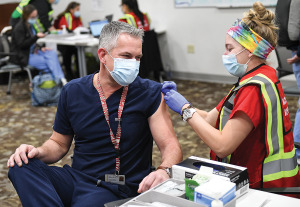
Dr. Rina Yadav runs a T-shirt company that donates half the proceeds to the American Cancer Society while she serves as internal medicine chief resident at Ascension St. Vincent.
The Department of Veterans Affairs announced Monday it would mandate coronavirus vaccines for its front-line workers, signaling what some experts believe could be a national pivot to such requirements.
In Indiana and other states, anger at perceived overreach by health officials has prompted legislative attempts to limit their authority, including new state laws that prevent the closure of businesses or allow lawmakers to rescind mask mandates.
A new report submitted to the Indiana Legislative Council calls for the regulation of “white bagging,” a practice that requires hospitals to buy drugs from an outside pharmacy, which delivers them premixed ahead of time of the patient’s visit. It is a growing practice, aimed at lowering the cost of care, but many providers say it can compromise care.
The narrower label means the drug might be offered to 1 million or 2 million Alzheimer’s patients, rather than the more than 6 million people with Alzheimer’s in the United States.
The role of the sticky substance in the brain has long divided researchers and is at the forefront again amid the FDA’s recent clearance of the first drug to treat the disease in almost two decades.
Drugmaker Biogen has until 2030 to complete a study confirming whether its new drug Aduhelm truly slows the brain-destroying disease. That’s under the terms of the Food and Drug Administration’s conditional approval of the drug.
The new gadget from VoCare Inc. is about the size of a smart phone and measures a person’s temperature, heart rate, blood pressure, blood glucose levels, blood oxygen saturation and heart rhythms.
Far more states have banned proof-of-vaccination policies than have created smartphone-based programs for people to digitally display their vaccination status.
Data presented to advisers to the Centers for Disease Control and Prevention adds to recent findings of rare cases of myocarditis—inflammation of the heart muscle—after the second dose of the Moderna or Pfizer-BioNTech vaccine.
A vascular surgeon in Bloomington is suing Indiana University, claiming it unfairly revoked his hospital privileges and spread false information about him in an effort to dry up referrals and exert monopoly control in the market.
Critics have blasted the approval of Aduhelm, saying the drug—with a list price of $56,000 a year per patient—offers false hope while threatening Medicare’s financial health and patients’ pocketbooks.