
Lilly’s older Alzheimer’s drug fails to prevent disease in trial

Eli Lilly said the study concludes its clinical development of solanezumab, apparently shutting the door on one of the most closely watched experimental drugs over the past decade.

Eli Lilly said the study concludes its clinical development of solanezumab, apparently shutting the door on one of the most closely watched experimental drugs over the past decade.
Five of the top 10 research studies that received the most NIH funding at the medical school were for Alzheimer’s disease or brain aging, one of the school’s top priorities.

Donanemab’s ability to rapidly remove amyloid beta from patients’ brains prevented the required number of patients from receiving the drug for a full 12 months, Lilly said, resulting in the FDA rejection.
It’s the first drug that’s been convincingly shown to slow the decline in memory and thinking that define the disease. But the medication comes with downsides, including potentially serious side effects and the need for frequent drug infusions.
The Food and Drug Administration’s contentious approval of Alzheimer’s drug Aduhelm took another hit Thursday as congressional investigators questioned the integrity of the process.
An experimental Alzheimer’s drug modestly slowed the brain disease’s inevitable worsening, researchers reported Tuesday—but it remains unclear whether that will have an impact on people’s lives.
Gantenerumab’s demise is a boost for Indianapolis-based Eli Lilly and Biogen, which are also developing treatments for Alzheimer’s, said Tim Anderson, an analyst at Wolfe Research. Lilly shares were up 1.8% at midday.

The IU School of Medicine announced won a five-year, $48.8 million grant from the National Institute on Aging, a division of the National Institutes of Health, to create in mice genetic mutations similar to those found in people with late-onset Alzheimer’s.

The money will be used to study animal models of late-onset Alzheimer’s disease as well as perform rigorous testing of potential therapeutics in animals.
The upbeat news served as a stark contrast to the calamitous rollout last year of another drug, marketed as Aduhelm, sponsored by the two companies.
The ruling Wednesday was a remarkable turnaround for the much-debated medication that was previously rejected by the same group earlier this year.
The push by Eli Lilly and Co. will come despite an unfavorable ruling last week from Medicare that sharply restricts reimbursements for a drug in the same class.
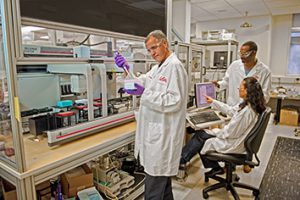
The FDA has agreed to speed up review of donanemab, but the Centers for Medicare and Medicaid Services is moving to limit reimbursement for drugs in this class to only patients in clinical trials.
Medicare officials stressed Tuesday that they did not take cost into account in the coverage decision, but rather whether Aduhelm is “reasonable and necessary” for treating Alzheimer’s patients enrolled in the program.
U.S. health secretary Xavier Becerra on Monday ordered Medicare to reassess a big premium increase facing millions of seniors this year, attributed in large part to a pricey new Alzheimer’s drug with questionable benefits.

Even as some drugmakers, including Indianapolis-based Eli Lilly and Co., are pushing to get experimental drugs approved, federal regulators are still dealing with a huge blowback over the controversial way they reviewed a new Alzheimer’s drug by rival Biogen.
The narrower label means the drug might be offered to 1 million or 2 million Alzheimer’s patients, rather than the more than 6 million people with Alzheimer’s in the United States.
The role of the sticky substance in the brain has long divided researchers and is at the forefront again amid the FDA’s recent clearance of the first drug to treat the disease in almost two decades.
Eli Lilly and Co. shares jumped more than 9% Thursday morning after it received “breakthrough therapy” designation for donanemab from the U.S. Food and Drug Administration, putting the drug on a path that could expedite its development.
Critics have blasted the approval of Aduhelm, saying the drug—with a list price of $56,000 a year per patient—offers false hope while threatening Medicare’s financial health and patients’ pocketbooks.