
Subscriber Benefit
As a subscriber you can listen to articles at work, in the car, or while you work out. Subscribe Now
The laps get tougher as they go. The laps around the sun, that is. You hit 93 and you’ve got all sorts of mechanical issues going on with worn-out parts and warning lights and red flags on your way to the finish line.
Mel Kenyon can deal with it, though. The evidence suggests he can deal with anything. He suffered life-threatening burns in a horrific racing accident and came back to win again. He competed with the best drivers of his era while grossly underfunded. He was still racing competitively in his seventies. He’s never backed off from his wedding vows either.
He doesn’t move as quickly as before and it takes longer to recall names, but his handshake — with the good hand — is firm and his upbeat nature is inspiring. But given all the physical and emotional challenges of his life in racing, it’s fair to ask: Was it all worth it?
He pauses, lets out a slight laugh, and says, “Yeah, I’m still here.”
That alone elevates his status. Born on April 15, 1933, he’s the oldest living person to have raced in the Indianapolis 500. So “still here” is indeed an accomplishment. He can smile throughout a conversation about his life and even chuckle about some of the most challenging episodes because he has a garage full of success and respect to show for it.
He won 398 midget feature events, including 111 USAC races, and placed second or third 633 times. He was a national midget racing champion seven times and a runner-up eight times. He has been inducted into both the national and international motorsports halls of fame.
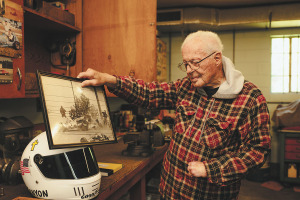
“As far as midgets, you could say he was the greatest ever,” Indianapolis Motor Speedway historian Donald Davidson says. “He won more races than most people have been in.”
Kenyon also fared well on the championship circuit, racing machines he and his brother Don assembled and maintained with private donations and used parts against the corporate teams with seemingly unending assets. But in eight Indy 500 appearances between 1966 and 1973, he had four top five finishes.
“Pretty good, since we didn’t have any money,” Mel says.
His greatest achievement, however, might be as an owner and mentor. He and Don, who lives next door, owned 3-K Racing, which sent nearly 400 entries into the midget world. Don, a fellow USAC Hall of Famer, built the frames. Mel worked on the engines, set up the cars for competition and often coached the driver who raced it. The list of drivers who raced their cars include A.J. Foyt, Mario Andretti, Jeff Gordon, Sarah Fischer and Ryan Newman.
Kenyon, you might say, was a driver’s driver. Casual race fans don’t know of him, and the diehards who do are dwindling in numbers. Those who knew him know, however.
“Mel Kenyon!” Mario Andretti exclaims when the subject is brought up via telephone. “I mean, you look at his records, it’s unbelievable. He was definitely the king of the midgets. Incredible career. And he never missed a beat, even after his accident at Langhorne.”
A life-changing moment
The accident at Langhorne was the defining moment of Kenyon’s career. It was a dividing line, a turning point, even a bridge of sorts. But he didn’t let it become a barrier.
It occurred on the 36th lap of a 100-mile champ car race — the first on a newly paved surface that had been converted from dirt — on June 20, 1965, at Langhorne Speedway in Pennsylvania. Kenyon’s engine blew, sending him into a long sideways slide into the outside wall. He was knocked unconscious after his head hit the car’s roll bar. With oil spraying from his car, two other drivers, Jim Hurtubise and Ralph Ligouri, lost control and crashed into him, with Ligouri’s car landing on top of Kenyon’s and catching fire.
Kenyon had opted to wear a cotton driving suit that day rather than a heavier fireproof model that he thought would be too hot and confining. He called the lighter uniform a “10-second suit” because it was chemically treated to withstand fire for only that long. The assumption was that by then the safety crew, armed with fire extinguishers, would arrive to drench the flames. But Kenyon sat, unconscious and wearing an open-faced helmet, in the collapsed cockpit of his car for at least three minutes (according to a newspaper report) and perhaps more than five (his belief) — “cooking,” as he puts it, in full view of fans.
Joe Leonard stopped, jumped out of his car and along with two spectators tried to pull him out of his car but they couldn’t remove his steering wheel to free him. Finally, late-arriving safety personnel arrived but they began spraying Kenyon’s car. Leonard screamed at them to spray Kenyon instead.
Kenyon suffered burns over 60% of his body, many of them third-degree. The local hospital wasn’t equipped to treat burn victims, so after an agonizing week spent under the spell of painkillers he was flown to what’s now called the Brooke Army Medical Center in San Antonio, wrapped like a mummy.
Dead skin was peeled off daily. He had to sleep and be fed while hanging upside down. He gobbled a steady diet of pain meds. He screamed from the agony so long and loudly that his voice was forever compromised.
The fingers and part of his thumb on his left hand had to be amputated. His right hand, which suffered “only” second degree burns because Leonard managed to pull it out of the cockpit away from his burning suit, lost its fingernails but was saved. He received 140 stitches on his face and neck. He still regularly wipes off scar tissue from his face and his beard would spread out in four different directions if he let it grow.
Oh, and his nose fell off. It was reattached, but he has no feeling in it to this day.
“I don’ t know if it’s dripping until it drops,” he says, smiling.
Later, with his new bride Marieanne at his side each day, even taking a job in the hospital to stay near him, an infection set in that brought more agony. It was then, near death, he “turned my life over to the Lord” and began healing. He was told he would have to recover in the hospital for nine months, followed by three months of rehabilitation. He was out in three.
He tried formal rehab for one day and decided he could do it better himself. Training like a boxer for a championship fight, he was racing again eight months later, in February. His performance in events in Tucson, Phoenix and Fresno earned him a ride with car owner Fred Gerhardt for the 1966 “500,” but Speedway officials were skeptical of his ability to race without his left hand. His father, Everett, and his brother devised an ingenious glove with a socket attached to the palm, which could be hooked onto a two-inch steel pin at the 10 o’clock position on the steering wheel. That not only enabled him to turn the wheel it gave him a bit of an advantage. He could turn the wheel as far as needed with his left hand because it never became detached unless he purposely removed it.
He impressed track officials in testing and then impressed the racing world by finishing fifth in the race with outdated equipment. The infamous first-lap accident sent him into the wall and tore the glove off his left hand, shredding skin from his knuckles, but he was able to stay in the race. He finished on three cylinders, one short of the norm.
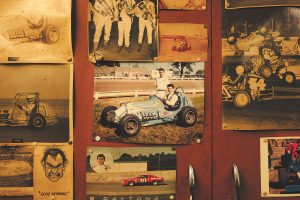
Kenyon always had to make do with less in the “500,” which made him the people’s champion. That was most evident in 1968 when his car was sponsored by the city of Lebanon. He and Don had only lived there for one year at the time, but when Mel approached the mayor, Bob Campbell, for help the entire community responded. With donations from local businesses, civic organizations and individuals, about $4,500 was raised to help finance the operation.
Kenyon kept costs low in every way imaginable. He went bargain shopping by rummaging through the trash containers outside other garages for used parts that well-funded teams, such as the one for Foyt, threw out after 1,000 miles. For Kenyon, it was like digging for gold. And, other than his brother, his crew members were volunteers, working for free. That included Mayor Campbell, who worked the fuel valve.
Kenyon finished third in ’68 and did it with a borrowed engine because his original was discovered to have a cracked block after he qualified. He earned about $45,000 in prize money.
“I had the whole town of Lebanon pulling for me and I want to thank each and every one of them,” Kenyon told reporters while signing autographs outside his garage after the race.
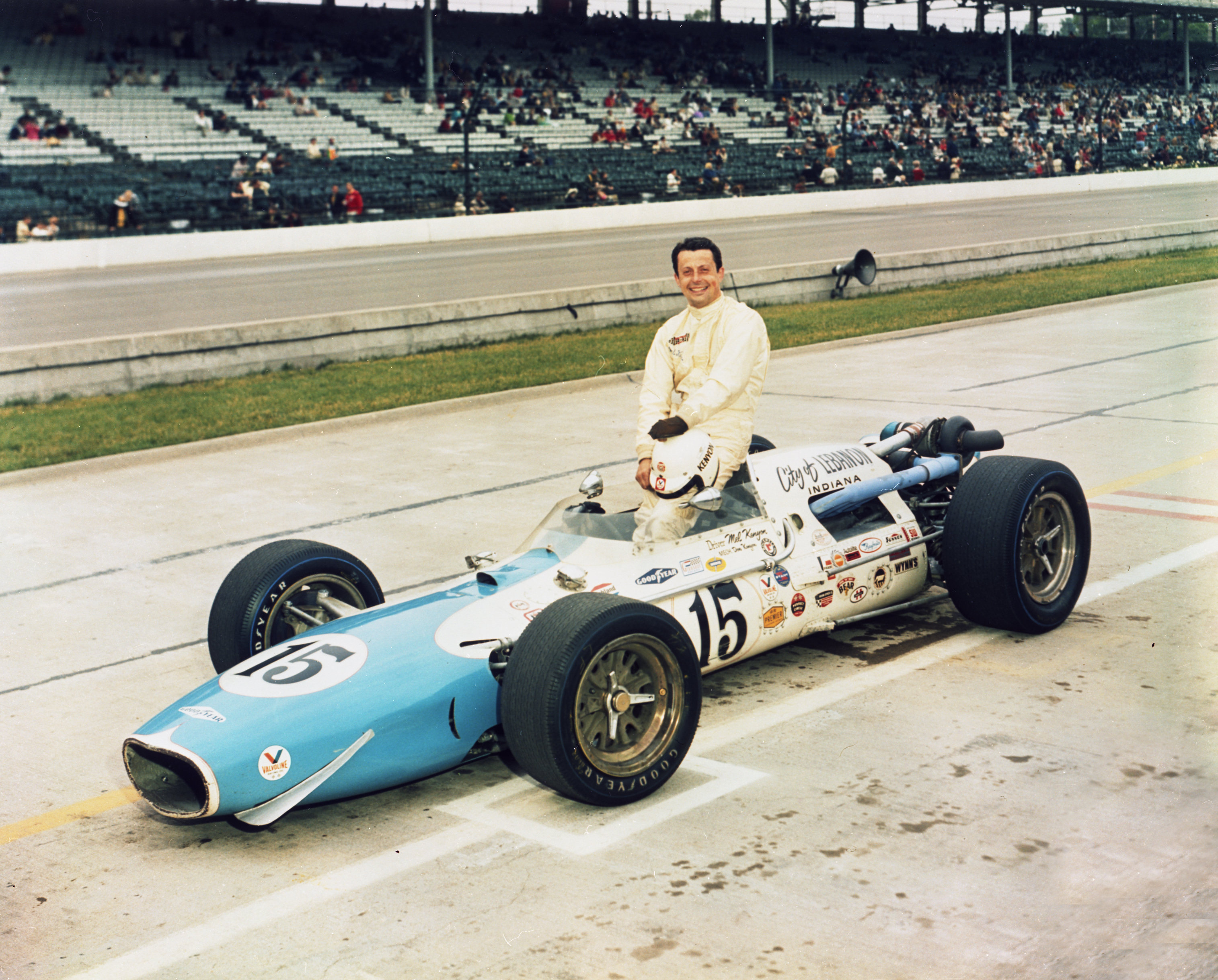
Kenyon’s most frustrating race came in the Michigan 200 in July 1972. He was cruising toward his first victory in the championship car division with less than two laps remaining but ran out of fuel on the backstretch and finished third.
Earlier in the Michigan race, Merle Bettenhausen crashed and was badly burned and lost his right arm. Bettenhausen would return to compete in midget races and cited Kenyon as his inspiration.
“Mel Kenyon has shown you can get a very successful race career going with most of one hand missing,” Bettenhausen said a couple of weeks after his accident.
Kenyon last raced in the “500” In 1973, finishing fourth. With adequate sponsorship dollars becoming too difficult to attract in a sport too costly for the townsfolk to cover, he focused on midgets for the rest of his career. That career officially ended in December of 2009, at 76, in an indoor event in Fort Wayne. Lack of sponsorship dollars forced him out, not Father Time.
From there he and Don focused on building and maintaining midgets. Mel says about 25 of their productions are still available for competition, and 17 of them competed in the previous two races. They recently closed 3-K Racing, however, and are selling off the equipment from the shop behind Don’s house. Father Time insists upon it.
Total commitment
The racing career only partly reveals the depth of Kenyon’s character. His marriages tell you more.
Marieanne, his first wife, was a commercial artist who painted portraits of the winning “500” drivers and an avid bicyclist. A few days after participating in a ride across Iowa, she was riding near their home when the family dog ran under her front wheel and sent her hurtling over the handlebars. Although wearing a helmet, she suffered a severe head injury that left her unable to walk, talk or move.
She lived in a nursing home in Lebanon for five years but made virtually no progress. Frustrated, Kenyon took her home and cared for her himself for the next four years, returning her temporarily to a care facility when he went racing. He cleaned her, dressed her, fed her, taught her to walk and talk again, and put her to bed each night. His devotion to her was such that he took her to speaking engagements with him, loading and unloading her in a wheelchair.
“It was astonishing the way he took care of her,” Davidson recalls. “And he never complained.”
She gradually got better, and Mel was convinced she was on her way to recovery. But she died in her sleep at home in 1999.
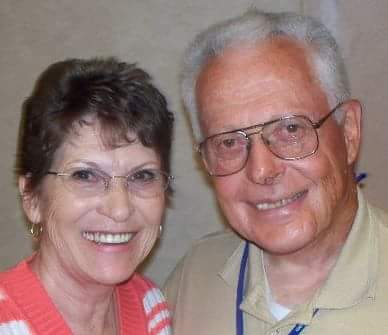
Kenyon remarried four years later. He and Joy have now celebrated 22 anniversaries. Although just 5-feet tall and 110 pounds, she was among the volunteers on his pit crew for five years. She once fell while helping push his car up a slope and suffered major cuts and bruises but wouldn’t let him take her to a hospital for exams and treatment. She now suffers from COPD and macular degeneration. Her son from a previous marriage, Jim, lives with them and helps but Mel is her primary caretaker.
He keeps an eye on his brother as well. Don had a recent heart scare and spent six weeks in St. Vincent Hospital but is home now.
Kenyon picked up a credential for the Speedway this year and would have liked to attend Carburation Day to see old friends such as Andretti and Foyt but didn’t believe he could leave Joy alone that long. Safe to say he would be a welcome sight if he could have made it.
“It would be awesome to see him,” says Andretti, who once won a midget race in Grand Rapids, Mich. in a car build by the Kenyon brothers.
“He was one of those guys who was easy to like. … He was always friendly and then you get on the racetrack he was as much of a tiger as anyone — but correct.”
Younger race fans wouldn’t recognize Kenyon, or even his name, if he showed up at the Speedway. But Andretti considers him a peer in the category of history’s greatest drivers.
“Absolutely,” says Andretti. “He was in the midgets, OK? That was his category of choice, but he ventured into the top level of Indy cars and he made the most out of what he had to work with. Somehow, he never landed with a top team, but I have 100% respect for what he was able to do. Between he and his brother, Don, they were racers. They figured out a way to make something out of very little.”
Mel Kenyon’s career, and life, has been full of struggle and hardship. He won so many races, but suffered major losses, too. Some so great that the question bears repeating: Was it all worth it?
“Yes,” he says, smiling. “Because I enjoyed racing.”•
__________
Montieth, an Indianapolis native, is a longtime newspaper reporter and freelance writer. He is the author of three books: “Passion Play: Coach Gene Keady and the Purdue Boilermakers,” “Reborn: The Pacers and the Return of Pro Basketball to Indianapolis,” and “Extra Innings: My Life in Baseball,” with former Indianapolis Indians President Max Schumacher.
Clarification: This story has been updated to clarify the nature of a fall Mel Kenyon’s wife, Joy once took and her current health.
Please enable JavaScript to view this content.
I had the pleasure of watching Mel Kenyon race midgets for years. Truly one of the best – when he was on the track, no one else stood a chance!