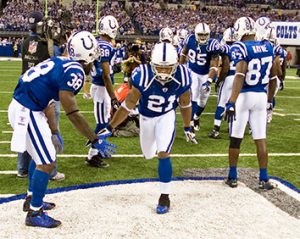
UPDATE: Players vote to OK deal to end NFL lockout
The NFL Players Association executive board and 32 team reps have voted unanimously to approve the terms of a deal to the end the 4½-month lockout.
Along with players’ salaries and contract terms, revenue sharing among the NBA’s 30 team owners is becoming the wild-card issue that could blow the lid off contract negotiations.
Ten weeks into the owners' lockout of the players, the NFL is seeing the early signs of cracks in fan loyalty. "Fans want certainty," Commissioner Roger Goodell said Wednesday at the end of the league's spring meetings in Indianapolis.
Competition from a new, state-of-the-art Rolls-Royce factory in Virginia drove contract talks in Indianapolis between the company and a union representing 1,700 of its workers here.
A bill to restrict Indiana teachers' collective bargaining rights has cleared its final legislative hurdle, becoming the first part of Republican Gov. Mitch Daniels' sweeping education agenda to make it to the governor's desk.
The NFL and the players' union decided Thursday to keep the current collective bargaining agreement in place for an additional 24 hours so that negotiations can continue.
The NFL and the players' union no longer have months or weeks or days to reach a new collective bargaining agreement. If they don't get it done before Thursday turns to Friday on the East Coast, pro football's first work stoppage since 1987 is almost a certainty.
Democratic legislators are staying away from the Indiana House chamber, blocking the Republican majority from conducting business while hundreds of union members crowd the adjourning hallways in protest of a contentious labor bill.
Union supporters shouted "lie" and "shame" at members of a Republican-led Indiana House committee who voted in favor of so-called right-to-work legislation, after impassioned arguments that it was aimed at weakening unions and would drive down wages.
Marsh Supermarkets Inc. has agreed to pay a total of $42,500 to settle a National Labor Relations Board case accusing the grocery chain of interfering with workers’ attempts to unionize.
The worst case scenario — no season — would mean the city of Indianapolis sustaining the most expensive hit in league history.
A lockout is predicted by many, but whether labor strife ultimately affects the 2012 Super Bowl in Indianapolis remains to be seen.
Irving Ready-Mix was ordered to restore pay to workers that had been cut by nearly $3 an hour and to recognize the union as the collective bargaining representative of the employees.
A Republican-controlled Senate committee has advanced a bill that critics contend would strip Indiana teachers of their collective bargaining rights.
National Labor Relations Board accuses supermarket chain of intimidating employees at its Beech Grove store for supporting an attempt to unionize. The charges follow a similar complaint NLRB made in November involving Marsh’s Georgetown Road store.
Recent reform measures—aimed at blaming teachers’ unions for all that ails public schools—claim that negotiated agreements are a large part of student achievement problems. Yet research shows that Indiana students fare better in school corporations where teachers have the right to collectively bargain.
Too often, teacher contracts have put the interests of adults above the interests of students. Adults have all the power.
The city should not approve another hotel development until it is clear the hotel operator will not pursue the same low-wage path of those who came before it.
Our ruin absent heroic stances at the Statehouse and the Governor’s Office, is not only politically likely but mathematically certain.
No doubt about it. My vote for collective bargaining rights for teachers as a state senator in 1973 was a big mistake. Not my only miscue in public life, but a whopper.