

Rare warning from Walmart during trade war: Higher prices are inevitable
Walmart imports general merchandise from dozens of countries. But China, in particular, represents a big chunk of volume in certain categories like electronics and toys.
Walmart imports general merchandise from dozens of countries. But China, in particular, represents a big chunk of volume in certain categories like electronics and toys.

Online shoppers in the U.S. will see a price break on their purchases valued at less than $800 and shipped from China after the Trump administration reached a truce with Beijing over sky-high tariffs.
The news about the agreement between the United States and China sent the stock market and the value of the dollar soaring.
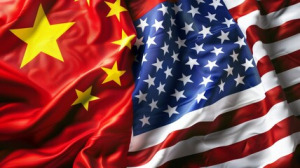
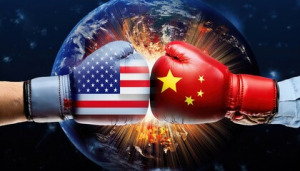
Negotiators for the two superpowers said Monday they had reached a deal to roll back most of their recent tariffs and call a 90-day truce in their trade war. Stock market investors rejoiced.
Representatives from Eli Lilly, Cook Medical and other Hoosier businesses gave advice about tariffs during the Indiana District Export Council’s annual trade and business conference Thursday at Newfields.
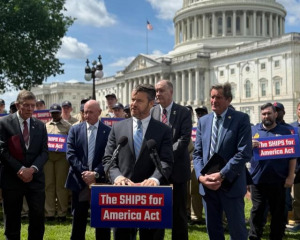
Young, R-Indiana, and fellow Sen. Mark Kelly, D-Arizona, reintroduced legislation to jumpstart the country’s “rusted” shipbuilding industry and increase onshore ship production that has largely shifted to China.
Top U.S. officials are set to meet with a high-level Chinese delegation in Switzerland in the first major talks between the two nations since Trump sparked a trade war with stiff tariffs on imports.
The United States already runs a trade surplus with the United Kingdom, making it a bit easier to find common ground.
China announced a barrage of measures meant to counter the blow to its economy from U.S. President Donald Trump ’s trade war, as the two sides prepared for talks later this week.

The nonstop route between Indianapolis International Airport and Dublin, Ireland, offers travelers a direct line to one of Indiana’s largest trade partners.
Consumers can expect higher prices and delivery delays when the Trump administration ends a duty-free exemption on low-value imports from China on Friday. But some might benefit.

Executives at some of the world’s biggest companies are faced with the tricky task of explaining how President Donald Trump’s tariffs are impacting their business as they discuss their latest quarterly reports.
Automakers and independent analyses have indicated that the tariffs could raise prices, reduce sales and make U.S. production less competitive worldwide.
There are no import surcharges on items that are already available in U.S. warehouses, keeping the prices of those goods generally stable, at least for now.
The lawsuit said the policy put in place by President Donald Trump has been subject to his “whims rather than the sound exercise of lawful authority.”
President Trump told reporters Tuesday that he planned to be “very nice” to China in any trade talks, and that tariffs would drop if the two nations were able to reach a deal.

Roche said Indiana would receive a new manufacturing facility for continuous glucose monitoring and expansion and upgrades at existing pharmaceutical, diagnostics and distribution operations.

Price hikes may drive cost-conscious shoppers to online resale sites, consignment boutiques and thrift stores in search of bargains or a way to turn their wardrobes into cash.

By making the expected blockbuster pill in the U.S., Lilly may be able to avoid the impact of Trump’s sweeping tariffs, including possible levies on pharmaceutical products.
Temu, which is owned by the Chinese e-commerce company PDD Holdings, and Shein, which is now based in Singapore, said in separate but nearly identical notices that their operating expenses have gone up “due to recent changes in global trade rules and tariffs.”