

Power conferences fill this year’s Sweet 16 for first time ever
The Sweet 16, a popular destination for bracket-busting mid-majors, is made up entirely of teams from power conferences, a first since the bracket expanded to 64 teams in 1985.
The Sweet 16, a popular destination for bracket-busting mid-majors, is made up entirely of teams from power conferences, a first since the bracket expanded to 64 teams in 1985.
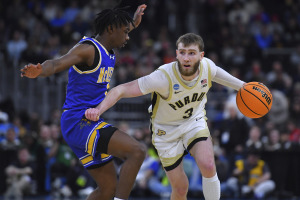
While game tickets and downtown hotel rooms were already expected to sell out regardless of which teams end up in Indianapolis to play, Purdue’s inclusion is likely to boost visitor traffic throughout downtown.
Thursday night’s NCAA Men’s Basketball Tournament games made up the most-watched prime-time first-round slate in March Madness history.
The survey found that about one-quarter of Americans fill out a men’s March Madness bracket “every year” or “some years.”
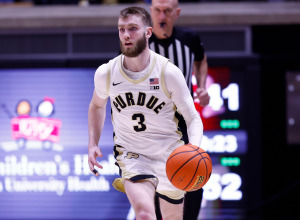
Purdue is in the Midwest Regional of the NCAA men’s basketball tourney, meaning the team will play in Indianapolis if it reaches the Sweet 16. Meanwhile, three schools from Indiana will play in the NCAA women’s basketball tournament.
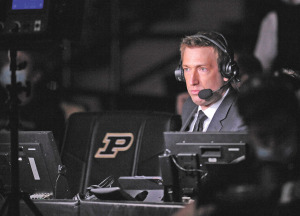
He will have worked 84 games by the time his broadcasting season ends, which is about 35 more than the industry norm for elite announcers.

The new rules will come into play when terms of the landmark $2.8 billion antitrust settlement reconfiguring the industry go into effect this summer.
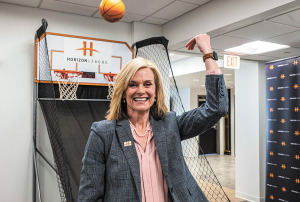
The Indianapolis-based Horizon League is set to wrap up its men’s and women’s basketball tournament at the Indiana State Fairgrounds next week.

Attorneys seeking approval of the $2.8 billion legal settlement for college sports said nearly 102,000 athletes have signed up to receive damages from the action.
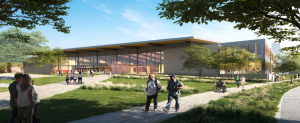
The James T. Morris Arena honors the civic leader and philanthropist who died last year at 81.

The association has at least one rep from every Big Ten team and a majority of SEC programs. Both conferences declined to meet.

The Carmel High School standout is among three former University of Pennsylvania women swimmers suing Penn, Harvard University, the Ivy League and the Indianapolis-based NCAA.
The NCAA policy change is effective immediately and applies to all athletes regardless of previous eligibility reviews under the NCAA’s prior transgender participation policy.
Charlie Baker, president of the Indianapolis-based NCAA, said the organization would “take necessary steps to align NCAA policy in the coming days, subject to further guidance from the administration.”

Gone is the 9:20 p.m. tipoff time that challenged all but the biggest fans to remain awake for “One Shining Moment.”
NCAA President Charlie Baker is banking on the momentum college sports appears to be gaining since preliminary approval of the House settlement, which calls for schools to pay players directly for use of their name, image and likeness.
The proposal, described as a “working document” ahead of next week’s NCAA convention, would grant the Southeastern Conference, Big Ten Conference, Big 12 Conference and Atlantic Coast Conference rights to manage postseason championships such as the men’s and women’s basketball tournaments.
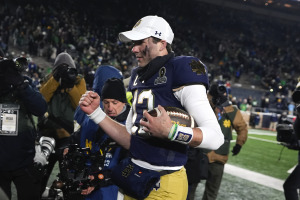
The seventh-seeded Fighting Irish (12-1) won their 11th straight—and their first playoff victory.
Also unveiled were the logos for the 2026 NCAA Division II and Division III men’s basketball championships, which will also be held in Indianapolis on the same weekend (April 4-6) as the Final Four.
The athletes whose lawsuit against the Indianapolis-based NCAA is primed to pave the way for schools to pay them directly also want a players’ association to represent them in the complex contract negotiations that have overtaken the sport.