
Indianapolis voters to consider tax increase for city’s schools this fall
The Indianapolis Public Education Corp. voted unanimously to place an operating referendum on the ballot to raise $90 million annually.
Read More
The Indianapolis Public Education Corp. voted unanimously to place an operating referendum on the ballot to raise $90 million annually.
Read More
Indiana Microschool Collaborative, which opened its first school last year, is planning to to open five more sites with spots for hundreds of students across eastern central Indiana.
Read More
Indiana students will have a new pathway to cybersecurity careers, backed by the College Board and the Indiana National Guard.
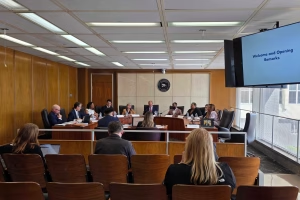
In addition to the referendum discussion Tuesday, the new Indianapolis Public Education Corp. appointed an acting executive director and approved a funding request for its work.

Among them are a new restriction on social media for minors and a ban on cellphones during school hours, which could change how students spend their time while reducing fights and distractions.
Graduates of bachelor programs must have earnings above those of a typical high school graduate, or around $33,000 in Indiana, for the program to keep operating and to receive federal student loan funding.

The nine-member board would be appointed by the Indianapolis mayor and oversee key aspects of schools within its boundaries, such as a transportation system and an accountability system that could be used to recommend closing inefficient or low-performing schools.

The legislation would require the state’s public colleges and universities to consider scores from the CLT as an alternative to SAT or ACT results.
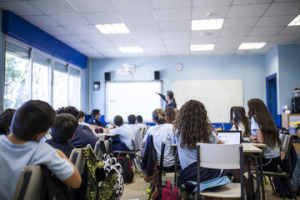
Indiana lawmakers have advanced a bill that would give a new governing body power over buildings, buses and taxes for Indianapolis schools, after adding key dates for when these changes would happen.
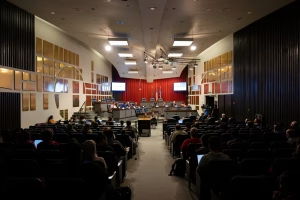
The Indianapolis Local Education Alliance’s recommendations would drastically change Indianapolis schools and reduce the power of the elected IPS school board.

Separate proposals would also restrict phones in schools and allow parents to set stronger filters on school-issued devices.
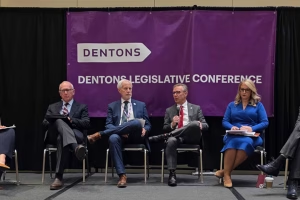
Indiana legislative leaders leaders are already thinking about how they could replicate the Indianapolis Local Education Alliance’s proposal in other parts of the state.
GOP lawmakers have introduced bills that would mandate that phones be securely stored at school or left at home during the whole school day.
The grants will support a wide range of initiatives like new student programming, teacher training, and updated STEM and performing arts spaces.

While Indiana legislative leaders haven’t yet detailed their education priorities for 2026, they have a list of unfinished business to tackle when it comes to schools.

This year’s referendums are a test case in voter support at a time when Indiana is lowering property taxes and increasing how much of that funding some districts must share with charter schools.

If approved, the plan would change the ways the state and school districts can merge and disburse federal grant funding.

The state is seeking donations to supplement state funding for the pilot program, which middle schools would be able to opt into, said Indiana Secretary of Education Katie Jenner.
State officials say their request would give schools more freedom to address their specific needs. But would funding reach those who need it?

State education officials say early intervention—along with a statewide shift to instruction backed by the science of reading—has played a critical role in improving proficiency.
Voucher use has surged in recent years as Indiana lawmakers loosened eligibility requirements, but the lack of rural private schools that accept them means many students miss out.

Among the changes would be a significant shift in School Improvement Grants, competitive grants that currently fund improvement plans at district and charter schools identified as low performing under the Every Student Succeeds Act.