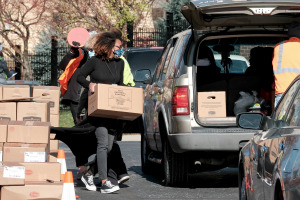
A group of prominent corporate, not-for-profit and government organizations is launching perhaps the most ambitious food-relief and sustainability program here in years.
The Food and Drug Administration on Monday cleared the experimental drug from Indianapolis-based Eli Lilly and Co. for people 12 and older with mild or moderate COVID-19 not requiring hospitalization. It’s a one-time treatment given through an IV.
The initial scarcity of the drug and the logistical complexities of administering it could mute its immediate impact on the pandemic and raise questions about whether it is being distributed to people in the greatest need.
Because of the initial limited supply, the number of doses each state receives will be determined by the number of confirmed cases and hospitalizations in a given week, federal officials said.
The Indianapolis drugmaker said Thursday evening it was awarded an emergency use authorization for its drug baricitinib to be used in combination with Gilead Sciences’ antiviral drug remdesivir in severely ill, hospitalized patients with COVID-19.
In a separate development, the FDA on Thursday gave emergency authorization to use of another anti-inflammatory drug sold by Eli Lilly, baricitinib, to be used with remdesivir.
During a year filled with uncertainty for many industries, including higher education, the small Catholic university is preparing to embark on another ambitious project.
The not-for-profit launched in 2013 as a way to bridge the gap between research universities and industry in life sciences. But its report card so far is decidedly mixed, and it just hired its third CEO.
In a time of political uncertainty, it’s hard to say whether the rules will withstand expected legal challenges from the pharmaceutical industry or whether the incoming Biden administration will accept, amend or try to roll them back entirely.
While efforts to create a COVID-19 vaccine have garnered the most headlines, Eli Lilly and Co. turned its attention to another critical need—helping those who contract the disease get better.
During IBJ’s Engage Indiana 2020 virtual event Thursday morning, Eli Lilly & Co. CEO Dave Ricks said he always believed enhancing diversity and inclusion was important, but this year showed him how serious a problem racial injustice is and fueled his motivation to do more to address it.
CEO Jeff Simmons said the company’s high-profile downtown Indianapolis headquarters will signal a cultural transformation at the company, which for most of its six decades of existence operated as a little-noticed subsidiary of Eli Lilly and Co.
The total doesn’t include the value of the land the state will give to Elanco Animal Health for the project. Even so, the combined city and state package is possibly the largest amount of tax breaks ever considered for an economic development deal in Indiana.
Elanco Animal Health Inc.’s announcement Friday that it will move its headquarters to Indianapolis came as a surprise to many business leaders in Greenfield. While disappointed, they say they are hopeful the move won’t be a significant blow to the city’s economy.
Lilly said it will enroll up to 500,000 people in its latest study, with at least 5,000 people expected to receive bamlanivimab therapy. The drugmaker is partnering with health insurer UnitedHealth Group to see if the drug will help high-risk people.
The medication will be provided by the U.S. government, which paid Indianapolis-based Lilly $375 million for an initial two-month supply of 300,000 doses as part of the Operation Warp Speed program.