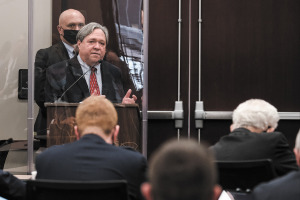
Effects of pandemic will slam state, local tax receipts
A former Senate budget writer said the hit to the state budget could be bigger than during the Great Recession, when state revenue dropped 15% over two years.
It was a fortuitous decision by legislative leaders heading into January to seek adjournment sine die by March 11 or 12.
The provision emerged at the Statehouse last month as a last-minute attempt to block the Indianapolis City-County Council from implementing two ordinances designed to protect tenants from predatory landlords.
Just in the past month or so, lawmakers have debated proposals to prohibit cities from regulating landlord-tenant relations, allow the attorney general to step in when a local prosecutor decides not to pursue a case, and cut funding to IndyGo—which might stop construction of future bus rapid-transit lines.
House Bill 1279, authored by Rep. Ed Soliday, R-Valparaiso, initially only addressed a regional development group in northwest Indiana. But an amendment sought to put teeth in a 2014 state law that required IndyGo to raise private dollars to help finance its mass transit operations.
U.S. District Judge Jane Magnus-Stinson said that because the women—a state lawmaker and three legislative staffers—didn’t work for Hill, they can’t sue him under federal laws meant to prevent workplace discrimination and retaliation.
Indiana lawmakers are trying to send a message to Republican Attorney General Curtis Hill: If he loses his law license, even through a temporary suspension, he could be forced out of office and prevented from seeking re-election.
House Speaker Brian Bosma is turning control over to Rep. Todd Huston, who isn’t wedded to policies of the past simply because they were justified when enacted and once worked.
Sen. Aaron Freeman, the Indianapolis Republican and former city councilor who authored the legislation, said his goal is not to cripple the bus system’s operations but to hold IndyGo accountable to a 2014 law that required it to fund some of its operations with private funds.
A bill that would prohibit businesses from using the implantation of some type of tracking or identification device as a condition of employment is headed to the governor.
A state Senate committee voted 8-1 Tuesday to endorse the bill that only permits cellphone use with hands-free or voice-operated technology, except in emergencies.
One senator says calls and emails from constituents have outnumbered contacts on any other bill this session.
Sen. Jim Merritt says his run last year for Indianapolis mayor has made him a better senator—one who’s more in touch with his constituents and who has seen the city’s poverty and crime problems firsthand.
Each year, one item seems to arise unexpectedly—innocently or intentionally—that seems to consume, as Statehouse denizens observe, all the time and calories.
State Rep. Dan Forestal, a Democrat facing charges of drunken driving and impersonating a public servant, said he will not seek re-election so that he can “focus on my mental health.”
Perhaps it is no surprise that Bosma decided to step down as speaker soon, then resign his House seat yet this spring.
IBJ’s Statehouse reporter Lindsey Erdody breaks down what bills are moving, which ones already are dead and what’s about to hit Gov. Eric Holcomb’s desk.
The demise of the promising Indiana Future Caucus is unfortunate, because no one else seems destined or determined to take the lead on issues critical to Hoosiers going forward.
Republican leaders of the Indiana General Assembly and Gov. Eric Holcomb have made addressing high health care costs a top priority this year, but the bills proposed to do so are unlikely to have much direct impact.
The legislation is meant to protect an individual’s right to sell or give his or her ticket to an event to someone else, should they choose to do so.