HETRICK: Much more than economic impact from a Final Four
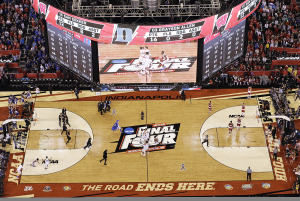
This year’s events delivered a return on investment far more powerful than the estimated economic impact.
Horizon League Commissioner Jon LeCrone is hopeful Butler University officials will not let their enthusiasm over the school’s
recent push to the NCAA Championship game run wild.
From the White House to Main Street, the Bulldogs opened eyes and turned heads.
More than 48 million viewers watched at least some of Monday night’s game, the most since 50 million tuned in for Arizona-Kentucky
in 1997.
Butler received so many visits to its main Web site, school officials had to beef up the computer system. School President
Bobby Fong is commissioning a study to gauge the value of the publicity earned through the Bulldogs' run to the Final
Four.
It was the third runner-up finish for the city in the past six months. The Indiana Fever lost in the WNBA finals, the Indianapolis
Colts lost the Super Bowl and now Butler.
National ticket search engine says about 4,500 remained Monday morning for the NCAA championship game at Lucas Oil Stadium.
Butler is winning the war of merchandise sales, leading the other three
schools in the Final Four. A victory tonight, sports marketers said, would increase those sales fivefold.
As is the case at Duke, Butler graduates about 90 percent of its players. As is the case at Duke, there’s more than mere lip
service paid to the classroom at Butler.
Indiana and Purdue may be the state's traditional basketball powerhouses, but it's little Butler—enrollment 4,200—that's big time now. Butler is writing a Hollywood hoops script, a sequel to "Hoosiers."
The NCAA and city put together a deal to cover insurance and liability issues for this year’s Final Four, but are still finalizing
an agreement that assures the event comes back regularly through 2039.
A debate rages over how Butler's spot in the Final Four will blunt the event's economic impact. But predicting the Final Four's true impact is fraught with unknowns.
The NCAA appears to be on the verge of expanding the men’s basketball tournament to 96 teams.
Butler University basketball coach Brad Stevens has an annual base pay of $350,000 with another $37,851 in benefits and deferred
compensation. Not bad for a 33-year-old. But it’s no comparison to what big-time men’s college basketball coaches make.
Itâ??s all about the whole, not the parts. They cut and move, move, move on offense. They defend like their scholarships depend on it.
Mediocrity in the athletic department was tolerated by the administration, winning wasn’t a priority and Tony Hinkle’s
five principles—humility, passion, unity, servanthood and thankfulness—had not been adopted as “The Butler
Way.”
Fans decked out in blue crowded Monument Circle and spilled onto Meridian Street in downtown Indianapolis, cheering on the
hometown Butler Bulldogs as they prepare for their first NCAA Final Four. Check out our photo gallery here.
Money proving to be a powerful motivator in earning Big Ten's support of NCAA tournament expansion plan.
Ticket brokers say a flood of tickets became available on the secondary market following losses by the No. 1-seeded Kansas
Jayhawks and Kentucky Wildcats.
The biggest chance Brad Stevens ever took, the best game plan he ever drew up, had nothing to do with a prized recruit or
some brilliant set of Xs and Os scrawled out on a greaseboard. It came on the day he decided to quit his job at Eli Lilly
and
Co. and to pursue his first love, basketball.