Even as Hotel Tango puts its employees to work making hand sanitizer, the company is advancing its plans to open a restaurant and tavern in Zionsville this summer.
Millions of small businesses are expected to apply for a desperately needed rescue loan Friday, a stern test for a banking industry that has had less than a week to prepare.
Last month’s actual job loss was likely even larger because the government surveyed employers before the heaviest layoffs hit in the past two weeks. The unemployment rate jumped from a 50-year low of 3.5%.
Getting his ring back from the 1980 NCAA championship was nice and all, but David “Poncho” Wright would regain something more important several years later: his life.
We check in with firms of all stripes to learn how they’re seeking to persevere—and how some are plotting to gain a competitive advantage when normalcy returns.
Gov. Eric Holcomb acknowledged the state is facing a potential mental-health crisis, and said he is committed to offering services to Hoosiers who are feeling troubled.
State unemployment specialist Josh Richardson talks with host Mason King about who is now eligible for benefits under an expansion approved by Congress as well as how soon they’ll begin receiving benefits and how the agency is adjusting to a flood of applicants.
State officials declined to provide details on specifically how the hotel is being used—including whether it is a treatment site for homeless individuals—to protect patient privacy.
In Indiana, 133,639 people filed unemployment claims in the week ended April 4, down from 139,174 the previous week, and way up from 75,522 the week before that.
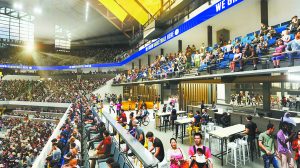
The Capital Improvement Board is significantly scaling back the first phase of a $360 million Bankers Life Fieldhouse renovation as uncertainty about working conditions and the NBA season have thrown a wrench into the construction schedule.
Consumer prices saw their largest monthly decline in five years, revealing the downward pressure that the coronavirus pandemic is exerting on the cost of gasoline, airfares, hotel rooms and other goods and services.
The Indianapolis-based hunger relief organization has seen demand for its services soar because of the coronavirus pandemic. The health crisis has forced the group to convert its biggest annual fundraiser into an online event.
The problem is that our current systems—the ones that do everything from keeping grocery stores stocked to hospitals functioning—are optimized to work very, very efficiently under normal conditions. But not necessarily when things go sideways.