
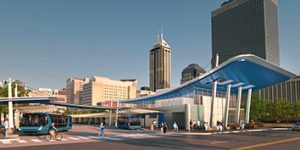
City to dub downtown transit center after Carson
Former U.S. Rep. Julia Carson was instrumental in securing funding for an Indianapolis public transportation hub.
Former U.S. Rep. Julia Carson was instrumental in securing funding for an Indianapolis public transportation hub.
The debate over whether Indianapolis residents should be able to vote this November on an income tax increase to pay for improved public transportation will soon heat up.
The first phase of the $198 million Red Line is slated to run from just north of Broad Ripple to the University of Indianapolis.
IndyGo has received the last of 21 fully electric buses. Those buses, equipped with lithium-ion batteries, can travel up to 130 miles on a single charge.
Construction work on the IndyGo transit center, which is expected to become a hub for most of Indianapolis’ bus lines, has been delayed by seven months. The project’s estimated cost has risen from $20 million to $26.5 million.
Officials say the first phase of a rapid transit line that should eventually connect Westfield to Greenwood won’t be delayed even though the Indianapolis region missed out on a share of $84 million in state funding from the Regional Cities Initiative.
Hamilton County leaders are getting a clearer picture of what a public transit bus system could look like and, according to a new study, the annual operating cost could range from $10 million to nearly $25 million.
The team charged with designing and engineering downtown’s $20 million transit center—which has begun to emerge south of Washington Street between Delaware and Alabama streets—took on three core challenges.
Fishers has paid out about $35,000 since agreeing to subsidize the commuter route to downtown Indianapolis last year.
A fund for public transportation could be debated before the House Ways and Means Committee after Rep. Randy Truitt filed a bill that would provide about $20 million more per year than Gov. Mike Pence proposed.
The shuttle offers WiFi, wheelchair accessibility, reclining seats, electrical outlets, DirecTV, a lavatory and a real-time bus-tracking interactive map.
The woman is suing over medical bills, lost wages and other financial damages due to a separated shoulder, concussion, bruising and cuts she sustained in the Dec. 20 crash in Seymour.
Two reverse-commute routes will serve the north Plainfield and Whitestown warehouse districts, taking workers from Indianapolis to major employers like Amazon, GNC, Ingram Micro and Tempur Sealy.
The City Line Trolley bus service has seen its passenger totals increase 31 percent since it added three new lines and expanded the number of stops from 118 to 275 last summer.
Indianapolis experienced one of the fastest gains in car-less households of any major city in a recent five-year period, according to U.S. Census data compiled by a University of Michigan researcher.
An Indianapolis software startup that hopes to win contracts from public-transit agencies across the country is protesting a no-bid deal by IndyGo.
A French company on Monday unveiled its first electric car-charging station in Indianapolis, where drivers will be able to rent plug-in vehicles for short-term trips later this year.
Starting this fall, IndyGo will have digital signs at downtown stops that show when the next bus is arriving, and passengers throughout the city will be able to check their phones or home computers for next-bus information.
IndyGo is updating its past studies on the feasibility of serving IPS high schools. A past study found that IPS spent $1,520 per student a year on transportation, while a city bus pass costs $330.
A grass-roots effort to salvage daily train service from Indianapolis to Chicago is solidifying into year-round advocacy for passenger rail in Indiana.