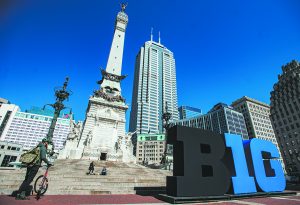
Local tourism, convention officials prepare for impact from coronavirus
Officials say no events have been canceled locally, but groups—including the NCAA and Visit Indy—are watching the news and weighing their options.
A growing number of employers have restricted international travel and are now considering what they might need to do within the U.S.
Over the past two years, Hancock Health has bought 140 acres of empty farmland at the Mount Comfort exit of Interstate 70 for a development it has named Hancock Gateway Park.
The Trump administration has announced it would allow states to add eligibility requirements, benefit changes and drug-coverage limits, which could limit what the government will spend for certain enrollees.
The Indianapolis-based drugmaker exceeded analyst expectations for both profit and revenue during the most recent quarter.
Indiana University Health’s new Schwarz Cancer Center is the latest addition to a crowded landscape of cancer centers and hospital oncology programs popping up around central Indiana.
Indianapolis-based Pet Wellness Clinics opened its first clinic in Fishers in 2005. The company became profitable a year later and has been in the black—and growing—ever since.
Republican leaders of the Indiana General Assembly and Gov. Eric Holcomb have made addressing high health care costs a top priority this year, but the bills proposed to do so are unlikely to have much direct impact.
The measures are largely focused on ending surprise billing for patients, creating an all-payer claims database and requiring health care providers to give patients costs estimates in advance.
IBJ’s John Russell has written about the Community case and talks with host Mason King about the details, what it means for Community Health and how the lawsuit fits into a larger effort by the federal government to claw back what it considers “unjust enrichment” by hospital systems.
Upscale, fast service, with lots of consumer touches: It’s a growing model for retail health care in Indiana and around the nation.
A deal to build a new family center at Broad Ripple Park could be just the first of several privately funded projects considered by the park system.
Founded in 1983, the practice has 28 physicians and annual revenue of $35 million, and shows little sign of slowing.
Starting out in 2005 with just four sets of sunglass frames, the eyeglass company now offers five lines for men and women with more than 100 frame styles.
The retirement community operator had revenue of $51.4 million last year, up 4% from 2017, according to its Form 990 tax return.
Three years after Indiana passed a law allowing doctors to prescribe drugs for patients without an in-person visit—using a computer, smartphone, video camera and similar technology—some health systems around the state are reporting higher use of virtual visits. St. Vincent, for example, sees hundreds of patients a month remotely for ailments ranging from minor rashes and sprains to follow-up visits for strokes.
The hospital system’s 45-year-old campus will likely need hundreds of millions of dollars in upgrades in coming years to keep it competitive long term.
Indiana health officials are investigating 30 cases of severe lung injury linked to vaping. Eight of those have been confirmed—most of them among individuals between the ages of 16 and 29. Earlier this month, the state confirmed the first death linked to vaping.
The spinoff, called Sexton Biotechnologies, has raised $5 million in outside investment and will spin off in October. The biotech develops cell and gene therapy tools used to grow cells for medical purposes.
Since the first pager was patented in 1949 and used in New York’s Jewish Hospital, millions of doctors have done their daily rounds in hospitals with the gadget clipped to their waistband, always ready to hear the beep that might signal a medical crisis on the other end. But hospitals are now phasing them out.