IndyGo CEO Inez Evans leaving after four years leading transit agency
Jennifer Pyrz, chief development officer for IndyGo, will become interim CEO after Evans’ departure.

Jennifer Pyrz, chief development officer for IndyGo, will become interim CEO after Evans’ departure.

U.S. Transportation Sec. Pete Buttigieg spoke Thursday afternoon in downtown Indianapolis, flanked by one-way streets that will be converted to two-ways under a recently announced $25 million federal grant.

Progress on the transit agency’s third rapid-transit bus line stalled a year ago when projected costs ballooned by $300 million over the expected $220 million price tag. Since then, IndyGo leaders have adjusted plans and cut costs down to a projected range of $370 to $390 million.

The videographer has produced five seasons of “Music in Transit,” an online series that showcases music performances on an IndyGo bus, and has worked on all eight seasons of the “Good Bones” HGTV home renovation show.

Event organizers plan to use the south end of Lucas Oil to accommodate 35,000 spectators for on-court activities, including the Slam Dunk competition, the 3-Point Contest and the Skills Challenge.
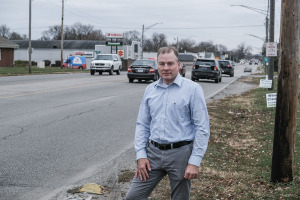
West-side leaders are pleased the city found $20 million for infrastructure improvements but remain disappointed that the area is missing out on the original $52 million in improvements the Blue Line was once scheduled to bring.
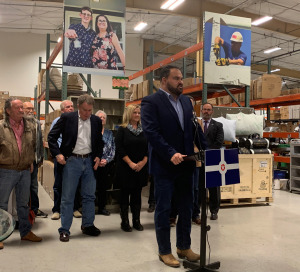
The infrastructure-improvement project is smaller than the $50 million plan that IndyGo dropped after an October board decision to alter plans for the Blue Line rapid-transit bus line on the west side.
IndyGo and transit advocates argue three consecutive years of legislative efforts by state Republicans to kill the project led to costly delays, while opponents say the undertaking was never financially feasible.
Hazen has distinguished himself for his work in road safety, donating hundreds of bike lights to a local cycling organization and passing them out for free to transit customers with bikes.

IndyGo is taking steps to make some of its regular bus stops more like the decked-out stops along its rapid-transit lines, starting with its first “super stop,” which it unveiled Monday.

IndyGo is planning three public comment sessions in October for the route redesign plan, which aims to increase efficiency. It will be up for a board of directors vote in November.

Republicans expressed concerns about IndyGo’s recent revelations that the cost of the Blue Line is now projected to go $300 million over its initial price tag, mostly due to the cost of connecting to Citizens Energy Group’s sewer system on Washington Street.
IndyGo is also considering whether to move the western-most segment of the Blue Line off Washington Street and onto Interstate 70, a move that would save money and appease lawmakers who have been critical of adding dedicated bus lanes to Washington Street.
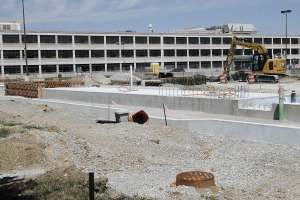
But there’s still a lot of work to do. Building of passenger stations has yet to begin; all progress so far has laid the groundwork for future construction.
The funding is part of a $1.6 billion U.S. Department of Transportation Federal Transit Administration effort supporting cleaner buses. IndyGo was one of just nine agencies nationally chosen to receive more than $30 million from the program.

Eight new episodes of “Music in Transit” will promote the under-construction Purple Line as well as Indiana musicians.
New York City-based Via Transportation Inc., which last year pulled out of the ride-hailing industry to focus on public transportation services, will lead the program.

Agencies are expected to use the money to prop up day-to-day operations, including staffing and payroll as well as cleaning and sanitization to limit the spread of illness in public transportation.
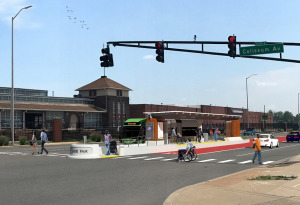
Nearly 70% of the total cost is set aside for infrastructure improvements, including sidewalks and stormwater drainage.

The House Ways and Means Committee on Monday tabled an amendment that would have conditioned the removal of some public transportation funding requirements on compliance with new lane minimums—which would’ve involved budget-busting redesign and land acquisition over several miles of the proposed 24-mile route.