
Mark Montieth: University of Indianapolis wrestler prepares for national championship
Lofty ambition flows through Derek’s veins, passed on from multiple sources and generations.

To refine your search through our archives use our Advanced Search
Lofty ambition flows through Derek’s veins, passed on from multiple sources and generations.
Downtown law firms say they have good reasons to remain in the heart of the city—from logistical concerns to the desire for a central location to the prestige factor they associate with a downtown address.

Of course, living downtown isn’t for everyone, especially in particular stages of life, but it’s a brilliant choice for those whose lifestyle affords it—and I don’t just mean in the financial sense.
Workers’ greater freedom to choose where to work suggests that downtown Indianapolis’ future depends on its ability to attract people as a place to live more than as a place to work.
While the state and the city have come together on major downtown projects over the years, there’s sometimes tension between what Indianapolis officials would like to see from the state and how the state views its responsibility to the capital city.

The best (and only) use case for a reorganization is to solve a specific business problem.
History: After noticing a high-priced but shabby leather tote bag in a mall in 2014, Christian Resiak was inspired to try making leather goods by hand in his unfinished basement. In 2015, with just $400 in his bank account, he quit his job at Angie’s List and decided to take Howl + Hide full time. […]

Cummins, Rolls-Royce, Eli Lilly and Co., AES and Elevance Health are among the city’s largest downtown employers and all say most of their workers have the option of working at home at least part of the time.

As state and city leaders grapple with reinvigorating downtown and contemplate the future economic drivers for the region, arguably nothing holds more promise than the further activation of two of the state’s most powerful research engines.
We have begun transforming underutilized city-owned properties into mixed-use residential hubs. That added housing comes alongside other major residential projects and will be surrounded by infrastructure that improves mobility for residents with or without a car.
The Indy Chamber has a central role activating the regional business community, collaborating with elected officials and not-for-profit partners, and mobilizing resources toward strategic, long-term solutions. We embrace these responsibilities.
We need a return to the type of civic responsibility and corporate investment that rebuilt Monument Circle, re-envisioned Circle Centre, and empowered employees to get involved in the downtown civic ecosystem.
Our lived experience is in stark contrast to the thinly veiled insulting words some nonresidents use to describe our neighborhoods and the business environment as of late.
It will take a collaborative effort from city officials, public safety, business owners and creatives to provide access to small-business owners and investors like myself who want to grow downtown and move forward, together.
To build on the attractiveness of the downtown residential sector, we should invest more in the kind of quality-of-life amenities we enjoy and seek out in other cities, like parks and open spaces, playgrounds, public art and public restrooms.
This means investments in affordable housing, new work opportunities, public safety, and enhancing downtown’s appearance and attractiveness.
There are commitments Indy’s regional business community must make to ensure today’s young Black professionals and other people of color feel a connection with our city. To do so, we must make a concerted effort toward equity.
According to crime data for the Mile Square over the past three years—the only such data available that includes figures for 2022—violent incidents are down from the pandemic peak years of 2020 and 2021 in all categories except robberies, which were up 43%, from 56 to 80.

Leonard Hoops has served as president and CEO of Visit Indy since 2011 and leads a team of 55-plus industry professionals who are charged with growing central Indiana’s nearly $6 billion convention, tourism and event business.
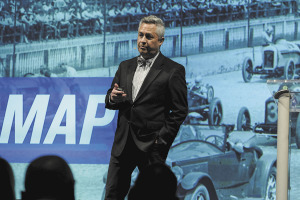
Wade Wingler will succeed Julia Huffman, who is retiring at the end of March after 11 years in the position.
